
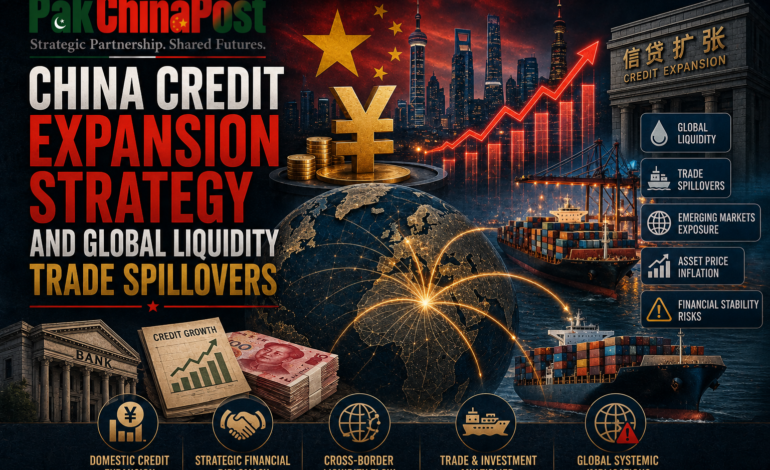
China Credit Expansion Strategy and Global Liquidity Trade Spillovers

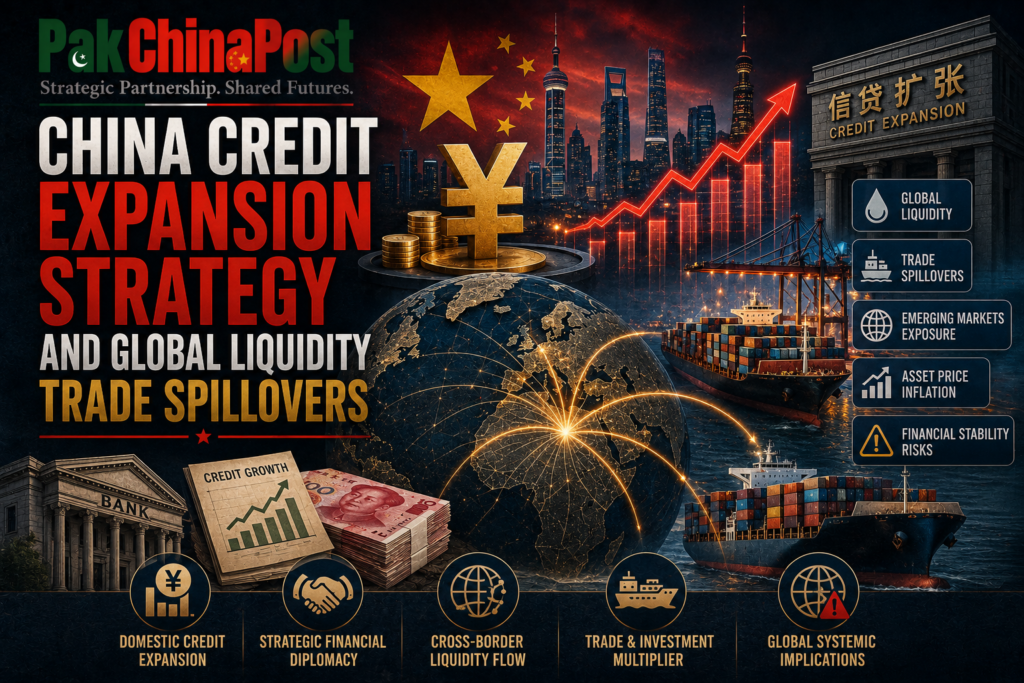
The contemporary global financial system is entering a phase in which credit is no longer merely an economic lubricant but an instrument of geopolitical adjustment, domestic stabilization, and external influence. Nowhere is this transformation more visible than in the evolving credit expansion strategy of China, which increasingly reflects a dual imperative: stabilizing internal demand conditions in the face of structural slowdown while simultaneously projecting financial influence outward through calibrated liquidity deployment across emerging and strategically significant economies. This duality has profound implications for global trade flows, debt architectures, and the latent balance of financial power in an increasingly fragmented international system.
China’s credit expansion cannot be understood through conventional macroeconomic lenses alone. It is not simply a response to cyclical downturns or temporary liquidity shortages. Rather, it is a structurally embedded policy instrument shaped by the interaction of domestic growth rebalancing pressures and external geopolitical constraints. As the Chinese economy transitions from investment led expansion toward consumption driven growth, the residual dependence on credit intensive infrastructure, real estate stabilization mechanisms, and state directed industrial financing remains substantial. This creates a persistent requirement for managed credit expansion, even in periods where aggregate demand appears structurally imbalanced.
The internal dimension of this strategy is closely linked to the stabilization of domestic economic expectations. The slowdown in the property sector, historically a major engine of credit absorption, has generated significant downward pressure on local government revenues, banking sector balance sheets, and household wealth effects. In response, credit channels have been selectively expanded to maintain liquidity in key sectors, prevent systemic contraction, and sustain employment levels. This has resulted in a recalibration of credit allocation rather than a simple expansion, with state owned enterprises, strategic industries, and infrastructure projects receiving prioritized access to financing.
However, this domestic reorientation is inseparable from China’s external financial behavior. As internal demand pressures necessitate sustained liquidity provision, excess capacity in financial capital is increasingly channeled outward through development finance institutions, bilateral lending arrangements, and participation in multilateral infrastructure initiatives. This outward movement of credit serves multiple strategic functions. It absorbs domestic liquidity surplus, supports export oriented industrial capacity, and extends China’s influence across emerging markets through long term financial engagement rather than short term trade transactions.
The global spillover effects of this credit architecture are both structural and asymmetrical. On one level, Chinese lending has provided critical financing for infrastructure development in many emerging economies that face constrained access to Western capital markets. Transport corridors, energy projects, and industrial zones across Asia, Africa, and parts of Latin America have been significantly shaped by Chinese credit flows. These investments have contributed to closing infrastructure gaps and facilitating trade connectivity in regions historically underserved by global capital allocation mechanisms.
Yet this expansion of credit has also introduced complex debt dynamics. In several cases, recipient economies have accumulated significant external liabilities denominated in foreign currency or structured through opaque repayment arrangements tied to future revenues or resource flows. This creates potential vulnerabilities related to debt sustainability, currency mismatch, and refinancing risk, particularly in environments of global interest rate volatility or export revenue disruption. The opacity of some lending structures further complicates risk assessment, making it difficult for international institutions to fully evaluate aggregate exposure levels.
From a global liquidity perspective, China’s credit expansion functions as a counter cyclical force within the international financial system. At times when Western monetary tightening reduces global dollar liquidity, Chinese outbound lending can partially offset contractionary pressures in specific regional corridors. However, this substitution effect is uneven and geographically concentrated, leading to a fragmented liquidity landscape in which certain economies remain integrated into Western financial cycles while others are increasingly influenced by Chinese credit conditions.
This dual liquidity system introduces a new form of financial multipolarity. Rather than a unified global credit cycle dominated by a single monetary center, the world is gradually experiencing the emergence of parallel liquidity regimes. One is anchored in dollar denominated capital markets and influenced by Federal Reserve policy cycles. The other is shaped by state directed Chinese credit allocation, often linked to strategic infrastructure and long term industrial cooperation frameworks. The interaction between these regimes is complex, occasionally complementary but increasingly competitive in strategic sectors such as energy infrastructure, digital connectivity, and logistics corridors.
The implications for global trade flows are equally significant. Credit expansion has a direct impact on trade financing, export competitiveness, and supply chain structuring. Chinese credit directed toward industrial capacity abroad can enhance export demand for Chinese machinery, construction services, and intermediate goods, thereby reinforcing domestic industrial utilization rates. At the same time, recipient countries may become structurally integrated into Chinese centric supply chains, altering traditional trade alignments and reducing dependence on Western oriented production networks.
This reconfiguration of trade geography is not merely economic but deeply strategic. Infrastructure financed through Chinese credit often comes with embedded logistical and technological standards, influencing long term patterns of industrial development in recipient countries. Over time, this can lead to path dependency effects, where economic structures become aligned with Chinese supply chains and financial systems, reducing diversification options and increasing exposure to Chinese economic cycles.
The geopolitical dimension of credit expansion is therefore inseparable from its economic logic. In a world characterized by intensifying strategic competition, financial flows have become extensions of geopolitical influence. Credit is deployed not only to generate financial returns but to secure long term strategic relationships, access critical resources, and establish infrastructural footholds in key regions. This form of financial statecraft represents a departure from traditional development finance models, which were more narrowly focused on economic efficiency and project viability.
For developing economies such as Pakistan, which occupy a central position in regional connectivity frameworks, the implications of Chinese credit expansion are particularly significant. On one hand, access to large scale infrastructure financing enables critical investments in energy, transport, and industrial modernization that would otherwise be difficult to realize under constrained fiscal conditions. On the other hand, reliance on external credit introduces long term repayment obligations that must be carefully managed to avoid debt sustainability pressures.
The challenge for such economies lies in balancing the developmental benefits of credit inflows with the imperative of maintaining macroeconomic stability and fiscal autonomy. This requires stronger project selection frameworks, enhanced transparency in borrowing arrangements, and integration of external financing into coherent national development strategies rather than fragmented project based accumulation.
At the systemic level, concerns are increasingly being raised about the potential for global liquidity fragmentation. As multiple credit systems coexist without full integration, the risk of misaligned financial cycles increases. Divergent interest rate environments, currency regimes, and credit allocation mechanisms can generate volatility in capital flows, particularly for economies exposed to multiple financial centers simultaneously. This underscores the need for improved coordination mechanisms between major financial powers and multilateral institutions to manage cross border liquidity risks.
Policy responses to this evolving landscape must be multidimensional. For China, maintaining financial stability while sustaining external credit engagement will require continued reform of domestic financial institutions, improved risk assessment frameworks for overseas lending, and gradual enhancement of transparency standards. For recipient countries, particularly in the developing world, strengthening debt management capacity, diversifying financing sources, and improving macroeconomic resilience will be essential to avoid overdependence on any single credit channel.
At the global level, there is an emerging need for a more inclusive financial governance architecture that reflects the realities of multipolar credit distribution. Existing institutions were largely designed for a unipolar or bipolar financial order and may not be fully equipped to manage the complexities of fragmented liquidity regimes. Enhanced data sharing, coordinated debt sustainability assessments, and standardized disclosure frameworks for cross border lending could help mitigate systemic risks.
Ultimately, China’s credit expansion strategy reflects a broader transformation in the nature of global finance. Credit is no longer simply a neutral instrument of economic exchange but a strategic resource embedded in geopolitical competition, domestic stabilization imperatives, and global development financing gaps. Its spillovers extend far beyond balance sheets, reshaping trade patterns, institutional dependencies, and the architecture of global economic governance.
The central challenge for policymakers, analysts, and institutions such as those contributing to strategic economic discourse in platforms like Pakistan Post is to interpret this transformation not as a temporary anomaly but as a structural reordering of global financial relations. In this new environment, credit flows will increasingly define not only economic outcomes but strategic alignments, making financial governance a core dimension of twenty first century geopolitical competition.
A Public Service Message


