
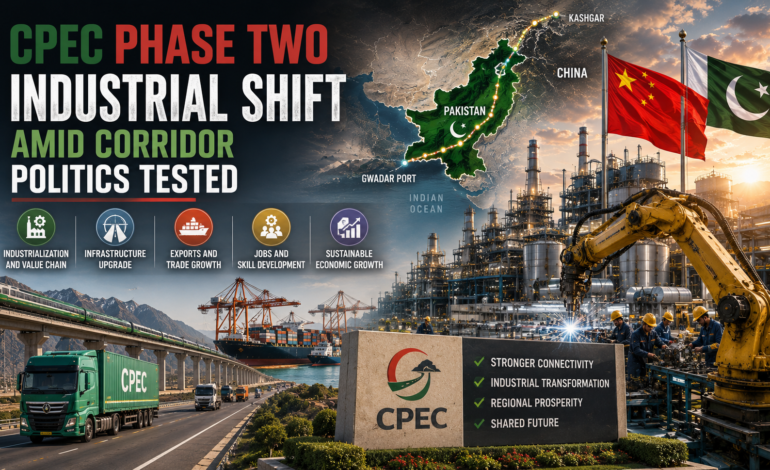
CPEC Phase Two Industrial Shift Amid Corridor Politics Tested

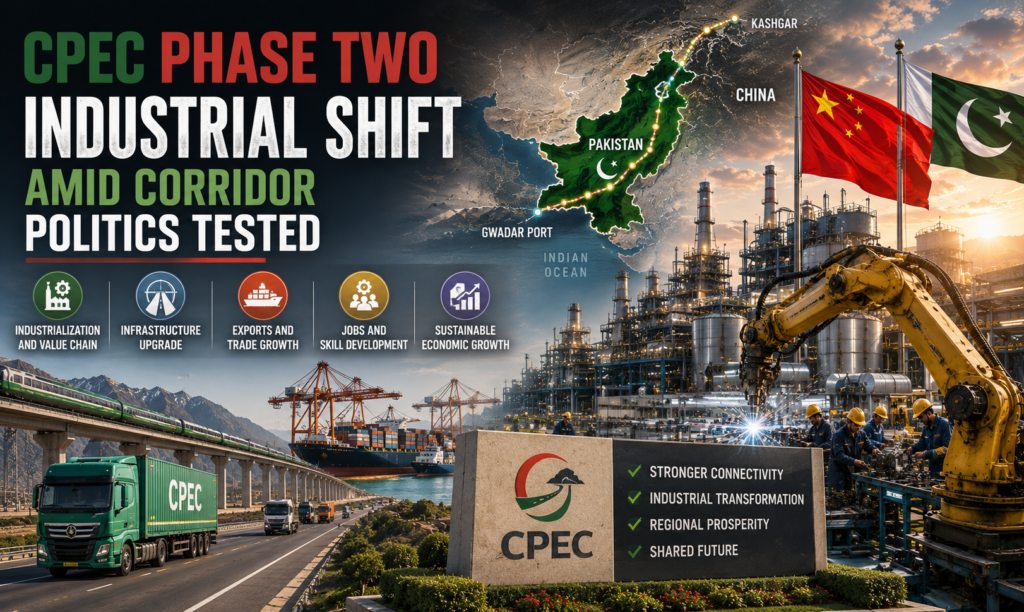
The second phase of the China Pakistan Economic Corridor is increasingly being positioned as a transition from hard infrastructure development toward a more complex architecture of industrial relocation, digital logistics integration, and agrarian modernization. Yet beneath this strategic rebranding lies a far more contested reality, one shaped by uneven provincial expectations, rising transparency deficits, evolving Chinese investment caution, and an expanding securitized governance model that increasingly blurs the boundaries between economic facilitation and strategic control.
CPEC’s first phase was largely defined by energy infrastructure and transport connectivity, which addressed immediate bottlenecks in Pakistan’s power generation and logistics networks. However, it also generated structural dependencies, particularly in energy purchase agreements and sovereign guarantees that have since contributed to fiscal stress. The second phase, in contrast, is framed as a shift toward industrial relocation and export oriented manufacturing ecosystems. This shift, in theory, aligns Pakistan with global trends of supply chain diversification away from concentrated manufacturing hubs. In practice, however, the realization of such ambitions is constrained by weak institutional coordination, regulatory unpredictability, and persistent concerns regarding the absorptive capacity of Pakistan’s industrial base.
At the core of the current phase is the attempt to develop Special Economic Zones intended to attract foreign manufacturing investment, particularly from China, into labour intensive and mid technology sectors. Yet these zones have faced significant implementation delays, underutilization, and uneven provincial distribution. The concentration of early development along specific corridors has triggered perceptions of structural imbalance, particularly among smaller provinces that view corridor geography as reinforcing rather than correcting existing inequalities in federal resource allocation. These perceptions are not merely political grievances but translate into administrative friction that slows down project execution and weakens policy coherence.
The question of debt transparency has emerged as another critical fault line. While official narratives emphasize concessionality and long term strategic partnership, external analysts and domestic fiscal observers increasingly point to opaque structuring of liabilities, contingent sovereign guarantees, and off balance sheet commitments associated with corridor projects. This opacity complicates Pakistan’s already fragile debt sustainability profile and limits its fiscal maneuverability in negotiations with multilateral institutions. It also introduces uncertainty for future investors who require clarity on risk allocation and repayment hierarchies.
China’s evolving investment posture within the corridor framework reflects a broader recalibration of its global overseas exposure strategy. There is a visible shift from large scale, state backed infrastructure lending toward more commercially disciplined, risk assessed, and phased investment models. This transition is driven by both domestic financial prudence in China and reassessment of geopolitical risk exposure in high volatility environments. For Pakistan, this implies that future financing will increasingly depend on project bankability, revenue certainty, and institutional credibility rather than strategic alignment alone.
Simultaneously, the securitization of economic space within CPEC zones has become more pronounced. Security apparatus involvement in project protection, administrative oversight, and operational coordination has expanded significantly. While this has improved physical security for foreign personnel and infrastructure, it has also introduced an additional layer of institutional complexity. Economic governance increasingly operates through hybrid civil military coordination frameworks, which, while effective in expedited execution contexts, may distort market driven investment logic and complicate regulatory predictability for private sector actors.
Local resistance dynamics further complicate corridor expansion. In several regions, land acquisition disputes, labour market displacement concerns, and perceptions of unequal benefit distribution have generated localized contestation. These tensions are not necessarily anti development in nature but reflect deeper structural issues of inclusion, compensation frameworks, and participatory governance deficits. Without addressing these underlying grievances, the legitimacy of corridor expansion risks erosion at the sub national level.
Comparative analysis with other Belt and Road Initiative economies reveals divergent trajectories. In parts of Southeast Asia, industrial relocation succeeded where regulatory consistency, export orientation clarity, and institutional insulation from political volatility were maintained. In contrast, cases where governance fragmentation and fiscal instability persisted have seen reduced investor confidence and stalled industrial transformation. Pakistan’s trajectory currently exhibits characteristics of both pathways, with strong strategic alignment on one hand and persistent governance unpredictability on the other.
The digital logistics component of CPEC Phase Two remains underdeveloped despite its central importance in modern supply chain integration. Efficient trade corridors increasingly depend on digitized customs processing, real time freight tracking systems, and integrated port to hinterland connectivity platforms. Pakistan’s current digital infrastructure, while improving, remains fragmented across agencies and lacks the interoperability required for seamless logistics modernization. This represents a critical bottleneck in transforming physical infrastructure into productive economic throughput.
Agricultural modernization, another pillar of the second phase, faces its own structural constraints. Despite agriculture being a dominant employer in Pakistan’s economy, productivity levels remain low due to water inefficiencies, fragmented landholding patterns, and limited mechanization. Corridor linked agricultural initiatives have yet to translate into systemic transformation, largely due to weak extension services, limited cold chain infrastructure, and inadequate integration into export oriented agro processing value chains.
Investor confidence remains closely tied to governance predictability. Frequent policy reversals, taxation unpredictability, and regulatory overlap between federal and provincial authorities continue to undermine long term investment planning. While special economic zone frameworks theoretically offer regulatory relief, inconsistent implementation weakens their credibility as stable investment destinations. Without institutional harmonization, corridor infrastructure risks becoming underutilized capital rather than productivity enhancing assets.
Hidden within the current phase is a deeper structural risk related to over securitization of development space. As economic zones become increasingly integrated with security oversight mechanisms, there is a risk that commercial logic may be subordinated to strategic considerations. This can create inefficiencies in resource allocation, reduce competition, and deter private sector participation, particularly from non aligned international investors who prioritize regulatory neutrality.
Fiscal exposure associated with corridor expansion also warrants careful scrutiny. While infrastructure investment is essential for long term growth, the repayment obligations tied to certain project structures introduce contingent liabilities that may constrain future fiscal space. In the absence of export expansion at a commensurate pace, these obligations risk becoming a structural burden on external account stability.
Policy recommendations must therefore focus on recalibrating the corridor from a geopolitically anchored infrastructure initiative into a commercially viable, institutionally transparent, and economically inclusive development framework. First, governance structures must be streamlined through unified corridor management institutions that reduce inter agency fragmentation and clarify decision making hierarchies. Second, provincial equity in project allocation must be institutionally guaranteed through transparent criteria based frameworks rather than discretionary allocation processes.
Third, debt structuring transparency must be enhanced to ensure that all corridor related liabilities are clearly reflected in national fiscal accounts, enabling accurate debt sustainability assessments and improving investor confidence. Fourth, security coordination mechanisms should be recalibrated to ensure that they facilitate rather than dominate economic governance, preserving space for private sector autonomy and market driven decision making.
Fifth, digital logistics infrastructure must be prioritized as a core strategic pillar rather than a supplementary component, with investment in interoperable customs systems, freight digitization, and port integration platforms. Without this, physical infrastructure gains will remain partially unrealized.
Finally, agricultural modernization must shift from pilot scale interventions toward systemic restructuring of value chains, including investment in cold storage networks, agro processing clusters, and export facilitation systems that connect rural production to global markets.
CPEC Phase Two thus stands at a critical inflection point. It is neither a guaranteed pathway to industrial transformation nor a failed experiment. It is a contested economic architecture whose success will depend on whether Pakistan can resolve deep seated governance fragmentation, align security and commercial imperatives, and construct a credible institutional environment capable of sustaining long term investor confidence while maintaining domestic political and regional balance.
A Public Service Message


