
Demographic Surge and Urban Governance Breakdown in Pakistan Today Era

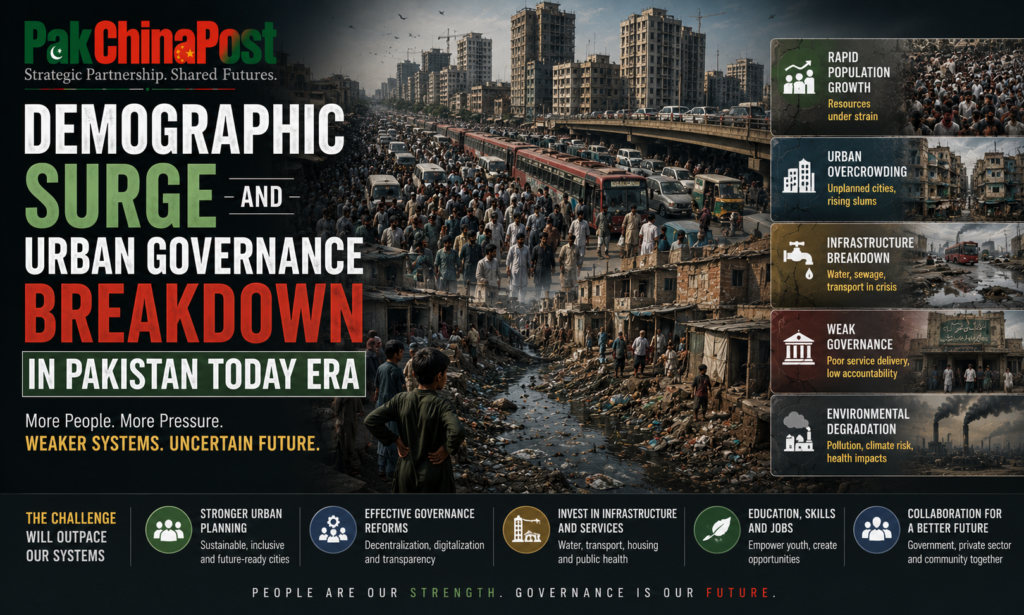
Pakistan’s demographic trajectory has entered a phase of structural acceleration that is no longer adequately interpretable through conventional development economics or incremental governance reform frameworks. The country’s population expansion, marked by sustained high fertility rates, uneven fertility transition, and intensified rural to urban migration, is generating a spatial and administrative overload that is increasingly visible in the fragmentation of metropolitan functionality. The phenomenon is not merely statistical; it is architectural in its implications, reshaping the very geometry of state capacity, urban livability, and institutional coherence. Within policy circles, including establishment level analytical assessments, there is a growing recognition that demographic momentum has begun to outpace the absorptive capacity of governance systems, thereby producing a latent but escalating risk environment that intersects with security, economics, and political stability.
Urban centres, particularly in Punjab and Sindh, are experiencing an unstructured expansion that defies formal planning logic. Cities are no longer expanding along regulated peripheries but are instead dissolving into peri urban sprawl characterized by informal settlements, unregulated land conversion, and infrastructural fragmentation. This has resulted in what can be described as a governance void, where municipal institutions retain nominal authority but lack operational depth. Water distribution, waste management, public transport, and housing regulation have increasingly shifted into hybrid spaces governed by informal actors, local power brokers, and fragmented bureaucratic jurisdictions. The outcome is a cityscape that functions through improvisation rather than design, and through negotiation rather than regulation.
The demographic surge has also generated a structural youth bulge that is not being absorbed into productive economic channels. Instead, it is being redistributed across informal labour markets, underemployment sectors, and gig based survival economies. This labour surplus, when combined with stagnant industrial expansion and limited formal job creation, produces a condition of chronic economic precarity. Establishment level assessments increasingly view this as a medium term volatility vector, where economic exclusion intersects with digital connectivity, producing new forms of mobilization, grievance articulation, and social mobilization outside traditional institutional frameworks. The risk is not immediate implosion but gradual erosion of social predictability.
Urban governance collapse is further intensified by fiscal centralization and administrative fragmentation. Municipal bodies remain structurally dependent on provincial transfers, which are often delayed, politically conditioned, or insufficient for capital intensive infrastructure maintenance. The absence of empowered local governments has created a vacuum in which urban planning is subordinated to short term political imperatives rather than long term spatial rationality. Infrastructure development is frequently reactive, driven by crisis events rather than anticipatory modelling. This has resulted in a cumulative infrastructure deficit, where transport congestion, housing shortages, and energy bottlenecks reinforce each other in a feedback loop of systemic stress.
From a strategic governance perspective, the demographic urban nexus is increasingly being interpreted as a slow onset security challenge. The conventional distinction between development policy and internal security is becoming increasingly blurred. Informal settlements are not merely housing anomalies but are emerging as dense socio economic ecosystems with their own governance logics. In the absence of institutional integration, these ecosystems can become parallel structures of authority, particularly in contexts where state presence is perceived as intermittent or extractive. This does not imply immediate insurgency risk but indicates a gradual weakening of uniform state visibility across urban geographies.
Environmental stressors compound these dynamics. Urban water demand is rising exponentially while supply systems remain antiquated, leaky, and unevenly distributed. Electricity shortages, waste accumulation, and air quality degradation are not isolated challenges but interlinked manifestations of infrastructural oversaturation. Climate variability further intensifies these pressures, particularly in flood prone and heat vulnerable zones, where urban populations are exposed to cyclical shocks without adequate adaptive infrastructure. The convergence of demographic pressure and climate stress produces a compound risk structure that is nonlinear in nature.
Within establishment circles, there is increasing concern regarding the long term implications of unmanaged urbanisation for internal cohesion. The city is no longer merely a site of economic production but has become a primary arena of political legitimacy contestation. When urban governance fails, it does not remain confined to administrative inefficiency; it translates into institutional distrust. This erosion of trust is particularly significant in a context where political narratives are already fragmented and where digital media ecosystems amplify perceptions of systemic failure in real time. The governance deficit therefore becomes simultaneously material and perceptual.
The labour market distortion emerging from demographic expansion further complicates fiscal stability. A growing proportion of the workforce remains outside the formal tax net, limiting the state’s revenue base while simultaneously increasing demand for public services. This asymmetry between fiscal capacity and demographic demand creates a structural imbalance that cannot be corrected through short term fiscal adjustments. Without broad based economic formalisation and productivity enhancement, the state risks entering a prolonged phase of fiscal compression under demographic strain.
Institutionally, the fragmentation of urban authority has led to overlapping jurisdictions between provincial departments, municipal bodies, and federal planning frameworks. This multiplicity of governance layers often results in policy incoherence, delayed execution, and diluted accountability. In practice, urban governance becomes a negotiated space where authority is diffused and responsibility is displaced. The absence of a unified metropolitan governance architecture remains one of the most critical structural deficits in Pakistan’s administrative system.
The security implications of demographic urban stress are indirect but significant. Rising inequality within urban spaces, combined with limited mobility pathways, can generate localized zones of exclusion. These zones may not immediately translate into overt conflict but can contribute to increased crime rates, informal coercion networks, and episodic unrest. Establishment level analyses increasingly emphasize the importance of preventive governance rather than reactive security responses, highlighting the need for integrated urban intelligence systems that map socio economic vulnerabilities in real time.
Policy responses must therefore move beyond conventional infrastructure expansion and toward systemic governance redesign. First, metropolitan governance structures require statutory empowerment with fiscal autonomy, enabling cities to manage their own revenue generation and expenditure cycles. Second, urban planning must be integrated with demographic forecasting models that anticipate migration flows and population density shifts over multi decade horizons. Third, housing policy must transition from incremental plot allocation systems to large scale affordable housing ecosystems supported by public private partnerships and regulatory facilitation.
Additionally, labour market formalisation must be prioritised as a central pillar of demographic management. Without integrating the youth population into productive economic structures, demographic expansion will continue to function as a pressure multiplier rather than a developmental asset. Vocational training systems, digital skill ecosystems, and industrial diversification strategies must be aligned with urban population dynamics.
Water, energy, and transport infrastructure require integrated planning frameworks rather than sectoral fragmentation. Establishment concerns increasingly highlight the necessity of viewing urban infrastructure as a unified strategic system rather than isolated service domains. The absence of integration leads to inefficiencies that compound over time, reducing overall system resilience.
At a broader strategic level, Pakistan’s demographic urban challenge must be reframed as a question of state capacity recalibration. The issue is not population growth per se, but the inability of institutional systems to absorb, regulate, and convert demographic energy into productive national output. Without this recalibration, urban centres risk becoming sites of chronic stress accumulation rather than engines of economic transformation.
The long-term trajectory will depend on whether governance systems can transition from reactive administration to anticipatory statecraft. This requires not only technical reform but also a shift in institutional imagination, where cities are understood as complex adaptive systems rather than administrative units. Failure to undertake this shift will deepen existing vulnerabilities and gradually erode the functional coherence of urban Pakistan.
In conclusion, the demographic surge is neither a temporary demographic anomaly nor a purely developmental concern. It is a structural transformation that is reshaping the foundations of governance, economy, and social order. The convergence of population pressure, urban fragmentation, and institutional inertia represents a slow burning risk architecture that demands immediate strategic attention. For policy makers, including establishment level stakeholders, the imperative is clear. Urban governance must be elevated from a sectoral concern to a core element of national security and long term state stability.
A Public Service Message