
Water Scarcity and Hydro Strategic Instability in Pakistan Basin

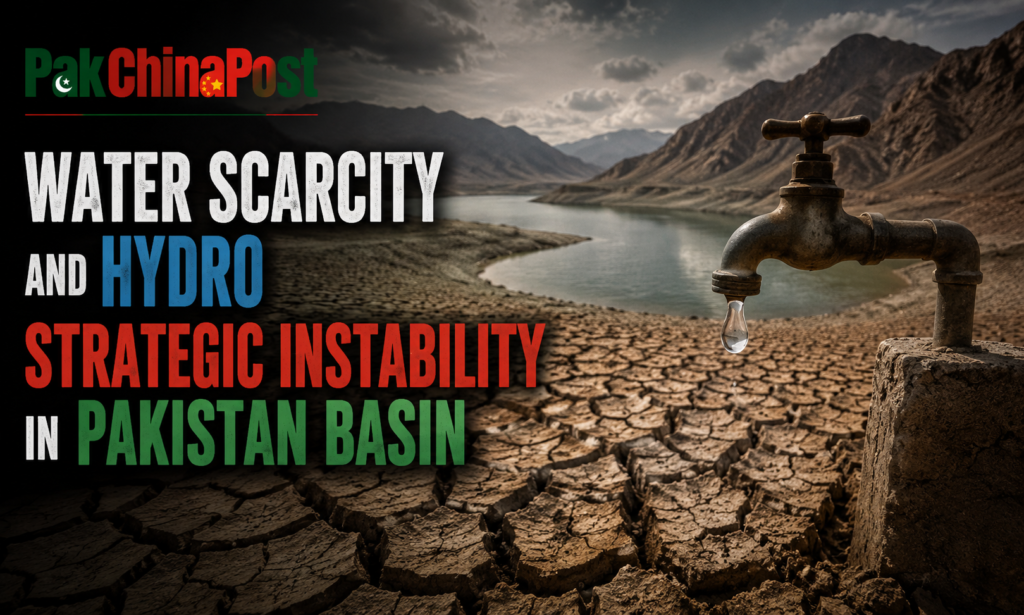
Water scarcity in Pakistan is no longer an environmental stress indicator confined to agronomic discourse; it has evolved into a structural determinant of internal cohesion, inter provincial equilibrium, and long term state survivability. The hydro logic of the Indus Basin is entering a phase of cumulative fragility where climatic volatility, demographic pressure, infrastructural decay, and governance fragmentation are converging into a single systemic risk architecture. Within policy and establishment level analytical circles, water is increasingly being reclassified from a resource management issue into a strategic stability variable with direct implications for national security calculus and federal integrity.
The Indus Basin, historically perceived as a stable hydrological system regulated through colonial and post colonial engineering frameworks, is undergoing a transformation that undermines its foundational assumptions. Glacial retreat in the northern catchments, erratic monsoon behavior, and increased evapotranspiration rates are altering flow predictability. These climatic disruptions are not episodic but structural, indicating a long horizon shift in water availability patterns. The resulting uncertainty is not merely technical; it is political, as water allocation systems designed on historical flow assumptions are becoming progressively misaligned with emerging hydrological realities.
At the inter provincial level, water has become an increasingly sensitive axis of political contention. The perception of inequitable distribution between upstream and downstream regions has intensified mistrust within the federation. This mistrust is not solely rooted in actual shortages but also in informational asymmetries, weak metering systems, and absence of transparent basin wide accounting mechanisms. The governance deficit in water data production has created a space where perception often overrides empirical calibration, thereby amplifying political friction. In establishment assessments, this informational opacity is viewed as a latent destabilisation vector, particularly during low flow seasons when distribution disputes become politically salient.
Agriculture, which remains the dominant consumer of water resources, is structurally exposed to this hydro stress convergence. The irrigation system, heavily reliant on canal based distribution with significant losses through seepage and inefficiency, is increasingly unable to meet rising demand from both population growth and crop intensification patterns. Groundwater extraction has emerged as a compensatory mechanism; however, this has led to aquifer depletion, quality degradation, and rising energy costs associated with deep tube well pumping. The agricultural economy is thus trapped in a paradox of declining water availability and increasing extraction intensity, producing diminishing marginal returns.
The strategic dimension of water scarcity extends beyond domestic distributional issues. The Indus Basin is embedded within a broader trans boundary hydrological framework where upstream infrastructural developments influence downstream flow regimes. While treaty based arrangements provide a formal structure for water sharing, the operational reality is shaped by seasonal variability, infrastructural sequencing, and data interpretation disputes. This creates a persistent undercurrent of strategic anxiety within downstream planning institutions, where water security is increasingly linked to geopolitical forecasting and contingency modelling.
Urban water stress is emerging as another critical dimension of the crisis. Rapid urbanisation has significantly increased municipal water demand, while supply infrastructure remains outdated and inefficient. Leakage rates, unequal distribution networks, and contamination issues have created a dual crisis of scarcity and quality degradation. In major metropolitan centres, water insecurity is no longer a peripheral inconvenience but a recurring governance failure that directly affects public trust in municipal institutions. The convergence of urban expansion and declining water availability is producing a new category of infrastructural vulnerability.
Climate change acts as a force multiplier across all these dimensions. Increased frequency of extreme weather events, including floods and drought cycles, has disrupted traditional water management predictability. Flood events destroy infrastructure and reduce storage efficiency, while drought cycles expose structural deficiencies in allocation systems. The absence of adaptive hydrological infrastructure, such as modern reservoirs, real time monitoring systems, and integrated basin management platforms, exacerbates these vulnerabilities. Establishment level analyses increasingly highlight that climate variability is not an external shock but an internalised structural condition of the basin.
Institutionally, water governance in Pakistan is characterised by fragmentation across federal, provincial, and local bodies with overlapping mandates and limited coordination capacity. This fragmentation produces policy incoherence, delayed project execution, and inefficient resource utilisation. The absence of a unified water governance authority with operational autonomy and technical capacity remains a critical structural gap. In addition, politicisation of water distribution decisions further undermines technical rationality, leading to short term allocation choices that compromise long term sustainability.
Groundwater governance represents one of the most under regulated dimensions of the crisis. Unchecked extraction, lack of licensing frameworks, and absence of aquifer mapping have led to uncontrolled depletion in key agricultural zones. This silent depletion is often invisible in political discourse but represents one of the most significant long term risks to food security. Once aquifers cross irreversible thresholds, recovery becomes economically and technically prohibitive, thereby locking regions into chronic water deficit trajectories.
The socio political implications of water scarcity are increasingly evident in rural distress patterns. Agricultural income volatility, crop failures, and rising input costs are contributing to rural economic stress, which in turn fuels migration towards urban centres. This migration loop intensifies urban water demand, thereby linking rural hydrological stress with urban governance challenges. The system thus operates as an interconnected stress circuit rather than isolated sectoral problems.
Within strategic policy frameworks, water is increasingly being conceptualised as a potential trigger for internal instability if governance reforms remain stagnant. The risk is not immediate conflict but gradual erosion of institutional legitimacy in water allocation processes. When populations perceive resource distribution as inequitable or opaque, trust in governing structures declines, creating fertile ground for political mobilisation around resource grievances.
Policy recommendations emerging from analytical assessments converge on the necessity of a comprehensive hydro governance overhaul. First, there is a need for establishment of a basin wide integrated water management authority equipped with real time monitoring, data transparency mechanisms, and enforcement capacity. Second, water accounting systems must be digitised to eliminate informational asymmetry and enhance distribution credibility. Third, pricing reforms must be introduced to reflect scarcity value while ensuring protection for vulnerable agricultural and urban populations.
Agricultural transformation is also essential. Transition from water intensive cropping patterns to climate resilient agricultural models must be incentivised through fiscal and technological support. Modern irrigation techniques, including drip and precision irrigation systems, must be scaled through public private partnerships. Without structural agricultural reform, water demand will continue to outpace supply regardless of infrastructural improvements.
Urban water governance requires parallel restructuring. Leakage reduction programs, wastewater recycling systems, and municipal metering frameworks must be prioritised. Cities must be integrated into national water planning systems rather than treated as separate administrative units. This integration is critical for ensuring coherence between supply and demand management.
At a strategic level, Pakistan must develop a formalised hydro diplomatic doctrine that integrates environmental forecasting with regional engagement frameworks. Water security cannot be addressed solely through domestic policy adjustments; it requires sustained engagement with upstream hydrological realities and trans boundary data coordination mechanisms.
In conclusion, water scarcity in Pakistan represents a slow onset structural crisis with far reaching implications for economic stability, federal cohesion, and national security. It is not a singular issue but a convergence point for climate stress, governance fragmentation, and demographic pressure. Without systemic reform, the Indus Basin risks transitioning from a historically stable hydrological system into a contested and volatile resource environment. For policy makers and establishment level stakeholders, the imperative is to reframe water not as a sectoral resource but as a foundational pillar of state stability requiring integrated, transparent, and anticipatory governance architecture.
A Public Service Message