
Pakistan China Partnership Faces Artificial Intelligence Information Warfare Challenges

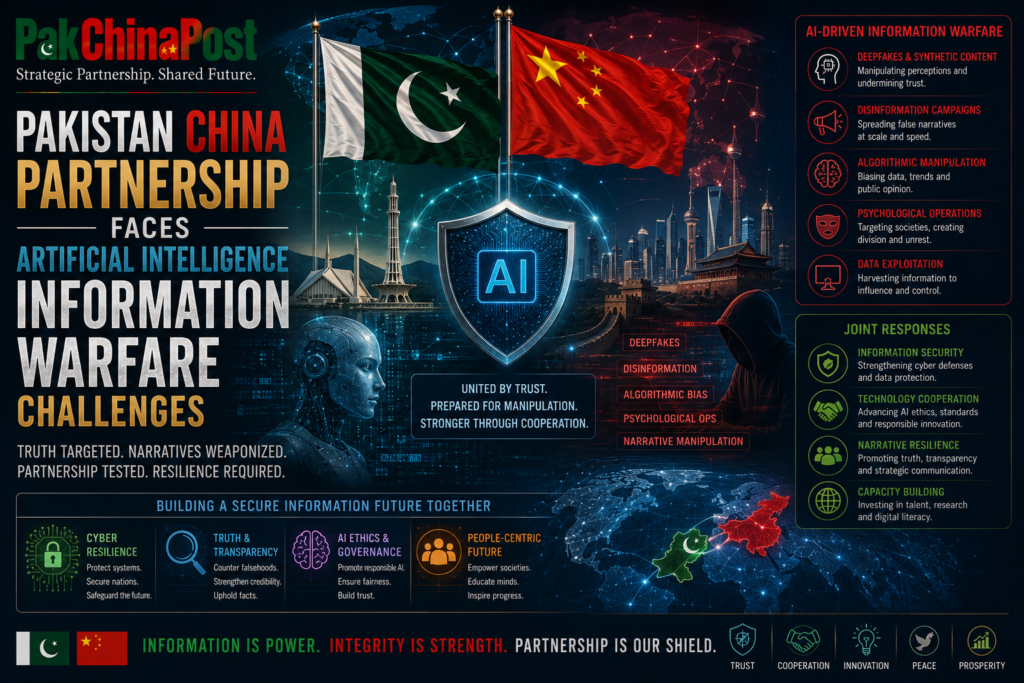
Pakistan and China increasingly confront a strategic environment in which infrastructure projects, economic integration, scientific cooperation and regional connectivity are no longer challenged solely through conventional geopolitical competition. They are simultaneously exposed to sophisticated information campaigns driven by artificial intelligence, synthetic media, algorithmically amplified misinformation and digitally coordinated influence operations designed to weaken public confidence in long-term development partnerships. As bilateral cooperation expands beyond physical infrastructure into digital connectivity, financial integration, technological innovation, industrial collaboration and strategic security coordination, the information environment itself has become an operational theatre where perception increasingly influences policy, investment, diplomacy and national resilience. The contest surrounding development partnerships is therefore no longer confined to negotiations between governments but extends into digital ecosystems where fabricated narratives can rapidly reshape domestic and international opinion before institutions possess sufficient time to verify or respond.
Artificial intelligence has fundamentally transformed the scale, speed and sophistication of contemporary disinformation campaigns. Unlike traditional propaganda, modern synthetic content combines realistic imagery, cloned voices, manipulated videos, fabricated documents and automated social media engagement capable of creating entirely fictional events that appear authentic to ordinary audiences. The emergence of generative artificial intelligence has significantly reduced the financial and technical barriers required to produce convincing deceptive content. Non-state actors, organised criminal groups, foreign influence networks, ideological organisations and even commercial competitors can now manufacture persuasive narratives capable of influencing public attitudes toward strategic infrastructure, investment agreements and bilateral diplomatic initiatives.
Pakistan and China have become increasingly prominent subjects within this evolving information battlespace because their expanding cooperation carries implications extending beyond bilateral relations. Major transport corridors, energy investments, industrial zones, digital infrastructure, scientific collaboration and regional connectivity initiatives influence broader geopolitical calculations across Asia. Consequently, narratives surrounding these partnerships often become contested spaces where competing strategic interests attempt to shape international perceptions. Development projects that were traditionally evaluated according to economic indicators now encounter simultaneous campaigns questioning transparency, sustainability, governance, environmental standards, security arrangements and institutional credibility. Some criticism originates from legitimate policy debate, while other narratives emerge through coordinated manipulation designed primarily to generate uncertainty rather than informed public discussion.
The distinction between genuine criticism and organised disinformation has become increasingly difficult for policymakers, journalists and citizens to identify. Artificial intelligence enables fabricated evidence to imitate authentic reporting with remarkable precision. Deepfake videos may depict officials making statements never delivered. Manipulated satellite imagery can falsely suggest construction failures or environmental damage. Artificially generated financial documents may circulate online claiming contractual irregularities. Automated social media accounts can rapidly amplify these materials, creating the appearance of widespread public concern before professional verification occurs. Algorithmic recommendation systems then accelerate dissemination by rewarding emotionally provocative content regardless of factual accuracy.
The strategic significance of synthetic media extends beyond reputational damage. Development partnerships rely fundamentally upon political confidence, investor certainty, regulatory predictability and public legitimacy. Information manipulation targeting these foundations can delay infrastructure implementation, discourage foreign investment, complicate diplomatic negotiations and increase domestic political polarisation. Financial markets increasingly respond to digital narratives within minutes rather than verified institutional assessments. International media frequently encounter rapidly circulating online content before official clarification becomes available. Under such conditions, perception itself acquires measurable strategic consequences.
Pakistan’s evolving digital landscape presents both opportunities and vulnerabilities within this environment. Internet penetration continues expanding alongside increasing smartphone usage, digital financial services and online political participation. Social media platforms have become primary sources of information for significant segments of society. While this transformation strengthens democratic participation and economic inclusion, it simultaneously expands exposure to algorithmically amplified misinformation. Information consumers frequently encounter emotionally persuasive content without sufficient contextual verification. Confirmation bias, political polarisation and declining trust in traditional institutions further complicate collective resilience against coordinated deception.
China has similarly recognised artificial intelligence governance and information security as essential components of national strategic planning. Considerable institutional investments have been directed toward digital regulation, cybersecurity, artificial intelligence governance frameworks and technological innovation. Nevertheless, no nation remains immune from synthetic media manipulation because contemporary information ecosystems operate across jurisdictional boundaries. Content generated within one country may be distributed globally through decentralised digital platforms beyond the immediate reach of national regulatory authorities. Effective responses therefore require international cooperation alongside domestic institutional strengthening.
The evolving character of influence operations increasingly integrates artificial intelligence with psychological targeting. Rather than promoting singular false narratives, sophisticated campaigns frequently construct interconnected ecosystems of partial truths, misleading interpretations, fabricated evidence and emotionally resonant messaging. Individual pieces of misinformation reinforce one another through algorithmic repetition until broader strategic narratives appear credible despite lacking factual foundations. Artificial intelligence enables continuous adaptation of messaging according to audience behaviour, linguistic preferences and demographic characteristics, producing personalised influence campaigns operating simultaneously across multiple digital platforms.
International development partnerships present particularly attractive targets because infrastructure projects inherently involve long implementation periods, complex financing structures, technical documentation and extensive stakeholder engagement. Such complexity creates opportunities for selective information manipulation. Genuine administrative delays may be portrayed as evidence of institutional collapse. Routine contractual revisions can be represented as financial crises. Local security incidents may be exaggerated into systemic instability affecting entire investment portfolios. Artificial intelligence dramatically accelerates the production and distribution of such misleading interpretations.
Narrative competition surrounding Pakistan China cooperation increasingly reflects broader transformations within global strategic communication. Traditional diplomacy relied primarily upon official statements, bilateral meetings and established media organisations. Contemporary strategic communication now unfolds within decentralised digital environments where anonymous actors, automated networks and synthetic content influence international discourse alongside governments. Success therefore depends not merely upon producing accurate information but upon ensuring credible information reaches audiences before manipulated alternatives dominate digital attention.
Algorithmic amplification represents perhaps the most underestimated dimension of modern disinformation. Digital platforms optimise user engagement rather than factual reliability. Emotionally provocative content typically generates greater interaction than balanced institutional communication. Artificial intelligence exploits these algorithmic incentives by producing sensational narratives specifically designed to maximise visibility. Even when platforms eventually remove deceptive content, substantial reputational effects may already have occurred through rapid initial dissemination. Strategic communication therefore requires proactive rather than exclusively reactive institutional capabilities.
Media literacy has consequently emerged as an essential national security consideration rather than solely an educational objective. Citizens capable of evaluating sources, recognising manipulation techniques and verifying digital evidence constitute critical components of national resilience. Universities, research institutions and journalism schools should integrate artificial intelligence literacy, digital verification methodologies and information ethics into academic curricula. Professional development programmes for journalists, civil servants, educators and public officials should similarly incorporate advanced training concerning synthetic media identification and coordinated influence operations.
Pakistan possesses considerable academic capacity capable of contributing to national counter-disinformation strategies. Universities specialising in media studies, computer science, cybersecurity, behavioural psychology, political communication and artificial intelligence can establish interdisciplinary research centres examining emerging information threats. Collaboration between higher education institutions and government agencies would strengthen evidence-based policymaking while encouraging indigenous technological innovation. Academic independence simultaneously enhances public confidence because transparent research methodologies increase institutional credibility.
Professional journalism remains indispensable despite rapid technological transformation. Artificial intelligence cannot replace editorial judgement grounded in ethical standards, investigative methodology and institutional accountability. Media organisations should strengthen digital forensic capabilities capable of verifying images, videos, metadata and geolocation evidence before publication. Collaborative verification networks connecting national and regional news organisations would reduce duplication while accelerating collective responses against fabricated content. Fact checking should evolve from isolated newsroom functions into integrated components of strategic national communication.
Technology platforms likewise bear substantial responsibilities within contemporary information ecosystems. Platform operators possess unprecedented visibility concerning coordinated inauthentic behaviour, automated engagement networks and algorithmic amplification patterns. Greater transparency regarding content moderation policies, recommendation algorithms and coordinated influence detection would enhance public trust while supporting governmental and academic research. Cooperative engagement between platforms and national institutions should prioritise procedural transparency rather than politically motivated content regulation, thereby preserving freedom of expression alongside information integrity.
Artificial intelligence itself should be employed defensively to counter synthetic deception. Machine learning systems capable of detecting manipulated audiovisual material, identifying coordinated bot networks, analysing abnormal information dissemination patterns and monitoring emerging influence campaigns can substantially improve institutional response capacity. Pakistan should accelerate investment in indigenous artificial intelligence research focusing specifically upon multilingual misinformation detection reflecting national linguistic diversity. Dependence exclusively upon imported technological solutions may create strategic vulnerabilities because locally contextualised narratives often require culturally informed analytical models.
Strategic communication must equally evolve beyond conventional public relations. Effective communication concerning major development initiatives requires continuous transparency, timely disclosure, accessible documentation and regular engagement with local communities. Information vacuums inevitably attract speculation. Institutions responsible for bilateral projects should proactively publish verified progress reports, environmental assessments, financial updates and implementation milestones through accessible digital platforms. Public confidence grows when accurate information remains consistently available before misinformation emerges.
Institutional coordination remains essential because fragmented responses reduce overall effectiveness. Ministries responsible for foreign affairs, information technology, interior security, commerce, education, telecommunications and strategic communications should operate within integrated national information resilience frameworks. Clear institutional responsibilities, rapid information sharing protocols and coordinated crisis communication mechanisms would improve responsiveness during emerging disinformation incidents. National coordination should additionally include provincial authorities whose local engagement often determines public perception regarding infrastructure implementation.
Public diplomacy constitutes another increasingly significant instrument. International audiences frequently evaluate development partnerships through narratives circulating within global digital platforms rather than direct policy documentation. Pakistan and China should expand collaborative academic exchanges, journalist fellowships, cultural engagement initiatives and research partnerships encouraging independent observation of development outcomes. Authentic interpersonal engagement frequently proves more resilient against manipulation than centrally managed promotional campaigns. Transparency, accessibility and openness ultimately strengthen credibility more effectively than excessive message control.
Legal frameworks require careful modernisation to address synthetic media without undermining legitimate democratic discourse. Legislation should clearly distinguish malicious fabrication intended to produce measurable harm from protected political opinion, investigative journalism and academic debate. Excessively broad regulatory approaches risk reducing public confidence while unintentionally encouraging alternative unofficial information ecosystems. Independent judicial oversight, transparent procedural safeguards and internationally recognised human rights principles should therefore guide legislative development concerning artificial intelligence generated misinformation.
Cybersecurity institutions similarly require expanded mandates recognising the convergence between digital infrastructure protection and information integrity. Coordinated influence operations increasingly combine cyber intrusion, data theft, manipulated documentation and synthetic media dissemination within integrated campaigns. National cyber resilience strategies should consequently incorporate communication specialists, behavioural analysts and digital forensic experts alongside technical cybersecurity professionals. Whole of government coordination enhances preparedness against multidimensional information threats.
Regional cooperation offers additional strategic advantages. South Asia, Central Asia and broader Asian institutions increasingly confront similar challenges involving artificial intelligence generated misinformation targeting economic integration and regional development initiatives. Multilateral dialogue concerning digital governance, technical standards, verification methodologies and crisis communication would strengthen collective resilience while reducing duplication of institutional effort. Shared technological research and professional exchanges could further accelerate regional capacity development.
International organisations also possess important roles in establishing voluntary norms governing synthetic media, artificial intelligence transparency and responsible technological development. While geopolitical competition may complicate universal regulatory consensus, practical cooperation concerning digital verification standards, election integrity, humanitarian communication and disaster information management remains achievable. Pakistan should actively participate within emerging international discussions shaping future artificial intelligence governance while protecting national technological interests and strategic autonomy.
Establishment concerns increasingly extend beyond immediate project implementation toward broader questions of societal resilience. Modern national security encompasses cognitive security alongside territorial integrity. Public confidence in institutions, scientific expertise, democratic procedures and strategic partnerships represents critical national assets requiring systematic protection. Artificial intelligence generated disinformation seeks precisely to weaken these foundations by creating persistent uncertainty, institutional distrust and decision-making paralysis. Countering such threats therefore demands comprehensive national strategies integrating technological innovation with democratic legitimacy.
The private sector equally constitutes an indispensable partner. Telecommunications providers, software developers, cybersecurity firms, financial institutions and technology entrepreneurs collectively influence national digital resilience. Public private partnerships supporting artificial intelligence research, digital authentication technologies, secure communication platforms and verification infrastructure would strengthen domestic technological ecosystems while reducing dependence upon external capabilities. Innovation incentives encouraging indigenous cybersecurity industries could simultaneously generate economic opportunities and strategic benefits.
Future competition surrounding development partnerships will increasingly depend upon credibility rather than communication volume. Nations capable of demonstrating transparency, institutional competence, technological sophistication and information resilience will enjoy comparative strategic advantages. Artificial intelligence will continue transforming both legitimate communication and malicious deception. Attempting to suppress technological progress represents neither practical nor desirable policy. Instead, national competitiveness will depend upon adaptive governance capable of balancing innovation, openness, security and public accountability.
For Pakistan and China, strengthening bilateral cooperation within the information domain should become a strategic priority complementing existing economic, technological and security collaboration. Joint research concerning artificial intelligence governance, collaborative digital forensic laboratories, coordinated crisis communication protocols, academic exchange programmes and professional media partnerships would enhance mutual resilience against synthetic influence operations. Such cooperation should emphasise internationally credible transparency standards capable of reinforcing rather than replacing independent institutional accountability.
Ultimately, the strategic contest surrounding development partnerships will not be determined solely by infrastructure investment, technological capability or economic performance. It will increasingly be influenced by whether societies retain confidence in verified evidence amid expanding digital deception. Artificial intelligence generated narratives have transformed information into an operational domain where perception shapes investment, diplomacy, governance and national security. Pakistan and China therefore confront a common imperative to strengthen information verification, cultivate digitally resilient institutions, empower responsible journalism, invest in artificial intelligence capable of detecting synthetic manipulation, deepen academic research, modernise strategic communication and preserve public trust through transparency rather than propaganda. Durable development partnerships ultimately rest not only upon roads, ports, industries and digital networks, but equally upon credible institutions capable of ensuring that truth remains more persuasive than deception in an increasingly contested information age.
A Public Service Message