
Pakistan China Partnership Redefines Strategic Autonomy Through Middle Power Diplomacy


By Shafqat Ali Qureshi
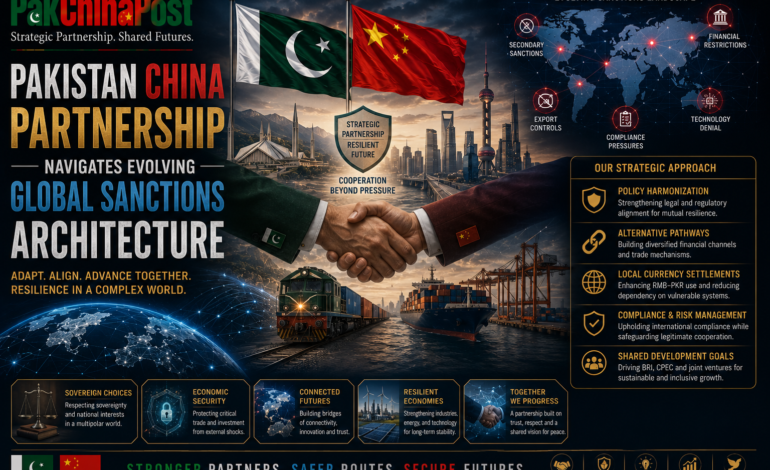
Pakistan and China increasingly find themselves operating within an international environment where strategic influence is no longer determined solely by military capability or ideological alignment, but by the capacity to manage competing relationships without sacrificing sovereign decision making. The emerging international order is characterised by overlapping security partnerships, fragmented economic networks, technological rivalry, contested supply chains, financial uncertainty, and expanding geopolitical theatres. Within this environment, middle power diplomacy has evolved from a secondary foreign policy instrument into a central mechanism through which states preserve national interests while avoiding strategic entrapment. For Islamabad and Beijing, the challenge is no longer simply strengthening bilateral cooperation. It is constructing an institutional framework capable of balancing regional stability, economic modernisation, diplomatic credibility, and strategic autonomy amid intensifying competition among major powers.
The international debate surrounding strategic autonomy has shifted considerably over the past decade. Earlier interpretations focused primarily on military independence or non alignment. Contemporary diplomacy increasingly defines strategic autonomy as the ability of states to maintain policy flexibility across multiple domains simultaneously. Governments seek diversified trade partnerships while maintaining security cooperation with different actors. They invest in technological innovation without accepting exclusive standards imposed by competing blocs. They participate in multilateral institutions while preserving bilateral strategic relationships. Rather than choosing permanent alliances, they cultivate multiple channels of engagement designed to maximise national resilience against external shocks.
Pakistan occupies a particularly significant position within this evolving diplomatic landscape. Geographically situated at the intersection of South Asia, Central Asia, the Middle East, and the Indian Ocean, Pakistan possesses strategic connectivity that extends beyond traditional security calculations. China similarly views international competition through a broader lens where infrastructure development, industrial integration, digital innovation, financial cooperation, and institutional partnerships collectively shape geopolitical outcomes. The convergence of these perspectives creates opportunities for both countries to redefine bilateral relations beyond conventional defence cooperation toward a comprehensive model of institutional diplomacy.
International media narratives frequently portray strategic partnerships through binary frameworks that assume states must inevitably align with one competing geopolitical bloc against another. Such interpretations increasingly fail to capture the complexity of modern international relations. Many countries maintain defence cooperation with one group of states while pursuing investment partnerships with another. They simultaneously participate in different regional organisations, financial institutions, technological initiatives, and diplomatic forums without perceiving inherent contradiction. Strategic flexibility rather than rigid alignment increasingly represents the defining characteristic of successful middle powers.
Pakistan has gradually demonstrated elements of this diplomatic flexibility despite facing significant structural constraints. Its economic partnerships increasingly extend across Asia, the Gulf, Europe, and emerging African markets. Security cooperation remains diversified across multiple bilateral relationships. Diplomatic engagement encompasses regional organisations, multilateral institutions, humanitarian initiatives, and development partnerships. China similarly maintains extensive economic relations with countries possessing differing political systems, strategic priorities, and security arrangements. These patterns indicate that successful diplomacy increasingly depends upon institutional predictability rather than ideological uniformity.
The evolution of global supply chains further reinforces the importance of middle power diplomacy. Manufacturing diversification, investment relocation, technological decoupling, and energy transition have created new opportunities for countries capable of providing political stability, regulatory consistency, and logistical reliability. Investors increasingly evaluate governance quality alongside market potential. Infrastructure alone no longer guarantees competitiveness. Predictable legal frameworks, transparent regulatory institutions, professional civil administration, commercial dispute resolution, and macroeconomic stability collectively determine investment attractiveness.
Pakistan and China therefore share an interest in strengthening institutional governance as a strategic diplomatic asset. International credibility increasingly derives from domestic administrative performance. Effective customs administration, efficient digital regulation, judicial certainty, fiscal discipline, investment protection, and policy continuity directly influence diplomatic influence because economic partners increasingly prioritise implementation capacity over political declarations. Diplomatic confidence emerges not merely from strategic dialogue but from demonstrated institutional competence.
Technological competition introduces another dimension requiring sophisticated diplomatic management. Digital infrastructure, artificial intelligence, quantum computing, cybersecurity, semiconductor manufacturing, telecommunications standards, satellite systems, and digital payment architecture have become central components of geopolitical competition. Countries increasingly confront pressure to adopt exclusive technological ecosystems. Middle powers, however, increasingly seek interoperable technological arrangements allowing participation across multiple innovation networks while safeguarding national digital sovereignty.
Pakistan’s technological development strategy can benefit substantially from diversified institutional cooperation rather than exclusive dependence upon any single technological ecosystem. China possesses considerable strengths in digital infrastructure, manufacturing capability, artificial intelligence applications, and industrial innovation. Simultaneously, Pakistan maintains educational, commercial, and technological engagement with numerous international partners. Strategic autonomy therefore requires regulatory interoperability capable of facilitating cooperation across multiple technological environments while protecting national cybersecurity, data governance, and critical infrastructure.
International financial architecture similarly reflects growing complexity. Traditional lending institutions increasingly coexist with regional development banks, sovereign investment funds, infrastructure financing mechanisms, climate finance initiatives, and digital financial platforms. Middle powers increasingly diversify financial partnerships to reduce vulnerability arising from excessive dependence upon individual funding sources. Financial resilience now represents a fundamental component of strategic autonomy.
Pakistan’s economic modernisation requires balanced engagement with multilateral financial institutions, regional development initiatives, private capital markets, sovereign investment partnerships, and bilateral development finance. China can contribute through infrastructure investment, industrial cooperation, manufacturing partnerships, technology transfer, and financial innovation. However, sustainable cooperation depends upon transparent project evaluation, prudent debt management, commercial viability, environmental sustainability, and effective institutional oversight. Such governance standards strengthen international confidence while reducing geopolitical criticism surrounding bilateral projects.
Contemporary international media often frame infrastructure initiatives through strategic competition narratives rather than developmental outcomes. Ports, railways, digital corridors, energy facilities, industrial zones, and logistics platforms are frequently interpreted primarily through security perspectives. While strategic implications cannot be ignored, excessive securitisation risks undermining legitimate economic cooperation. Pakistan and China therefore require proactive strategic communication capable of demonstrating developmental benefits alongside security considerations.
Institutional transparency represents one effective mechanism for addressing international scepticism. Independent economic assessments, environmental reporting, commercial disclosure, investment statistics, employment generation data, and regulatory compliance collectively strengthen international confidence. Predictable governance reduces uncertainty more effectively than reactive public diplomacy. International investors, development institutions, and diplomatic partners increasingly evaluate measurable institutional performance rather than political narratives.
Multilateral diplomacy offers another avenue through which strategic autonomy can be reinforced. Rather than relying exclusively upon bilateral engagement, middle powers increasingly utilise regional organisations, development forums, climate initiatives, trade negotiations, humanitarian cooperation, health security partnerships, and international legal institutions to expand diplomatic influence. Such diversified engagement reduces perceptions of exclusive alignment while strengthening policy flexibility.
Pakistan possesses opportunities to expand diplomatic leadership across regional connectivity, climate adaptation, disaster resilience, food security, counterterrorism cooperation, refugee management, maritime governance, and sustainable development. China similarly promotes multilateral engagement across numerous international platforms addressing infrastructure, development finance, environmental sustainability, public health, and economic cooperation. Joint initiatives within multilateral settings may therefore generate broader international legitimacy than purely bilateral arrangements.
Climate diplomacy increasingly demonstrates how middle powers can exercise constructive international leadership despite broader geopolitical competition. Climate adaptation, renewable energy transition, water resource management, biodiversity protection, carbon markets, and disaster preparedness require collaborative approaches transcending strategic rivalries. Pakistan remains among the countries most vulnerable to climate related risks, while China possesses substantial technological capabilities in renewable energy manufacturing, green infrastructure, and environmental innovation. Joint climate initiatives therefore possess diplomatic significance extending beyond bilateral relations.
Energy security constitutes another domain where strategic autonomy increasingly depends upon diversified partnerships. Global energy markets continue experiencing transformation driven by renewable technologies, hydrogen development, electricity interconnection, critical mineral supply chains, and energy storage innovation. Pakistan’s future energy resilience requires balanced investment across conventional resources, renewable generation, regional electricity trade, energy efficiency, and technological modernisation. Chinese cooperation can accelerate infrastructure development while broader international partnerships contribute financing, innovation, and market diversification.
Security cooperation similarly requires careful adaptation to changing geopolitical realities. Traditional military alliances increasingly coexist with intelligence sharing, cybersecurity coordination, maritime security, border management, counterterrorism cooperation, space surveillance, and critical infrastructure protection. Comprehensive national security now integrates economic resilience, technological capability, public health preparedness, financial stability, environmental sustainability, and institutional governance. Pakistan and China can strengthen strategic cooperation by expanding institutional coordination across these interconnected sectors while maintaining openness toward broader international collaboration where mutual interests exist.
International perceptions frequently underestimate the importance of governance continuity in sustaining strategic partnerships. Governments change. Political priorities evolve. Economic circumstances fluctuate. Long term diplomatic credibility therefore depends upon institutions rather than personalities. Professional civil services, independent regulatory authorities, parliamentary oversight, judicial integrity, diplomatic professionalism, and evidence based policymaking collectively provide continuity essential for sustained international confidence.
Pakistan’s diplomatic institutions have accumulated considerable experience navigating complex regional dynamics. However, institutional modernisation remains essential. Foreign policy increasingly intersects with economic planning, technological regulation, environmental governance, industrial policy, digital transformation, migration management, and public diplomacy. Effective diplomacy therefore requires integrated coordination among ministries, regulatory agencies, provincial authorities, private industry, research institutions, and security organisations. Fragmented policymaking reduces national competitiveness regardless of diplomatic ambition.
China similarly recognises the growing importance of institutional coordination across economic planning, technological innovation, industrial development, environmental management, and international cooperation. Bilateral engagement increasingly benefits from specialised institutional dialogue involving regulators, universities, research organisations, business communities, provincial governments, and professional associations alongside traditional diplomatic channels. Such multidimensional engagement creates resilience beyond political cycles.
Strategic communication represents another increasingly significant component of middle power diplomacy. Information competition now shapes international perceptions alongside conventional diplomacy. Digital media, think tanks, academic research, international journalism, commercial intelligence, and policy analysis collectively influence geopolitical narratives. Countries unable to communicate policy objectives effectively frequently encounter misunderstanding regardless of substantive achievements.
Pakistan and China should therefore strengthen evidence based public diplomacy emphasising transparency, measurable outcomes, independent research collaboration, academic exchange, media professionalism, and policy dialogue. Strategic communication should prioritise factual credibility rather than rhetorical competition. International confidence develops through consistent institutional behaviour supported by verifiable performance indicators.
Economic credibility similarly depends upon reform implementation rather than investment announcements alone. Regulatory predictability, contract enforcement, fiscal responsibility, tax administration, customs efficiency, labour market development, industrial productivity, export competitiveness, and financial transparency collectively determine international confidence. Middle power diplomacy increasingly begins within domestic institutions because external partnerships reflect internal governance quality.
Another emerging dimension involves human capital diplomacy. Universities, scientific cooperation, vocational education, healthcare partnerships, digital skills development, and professional exchanges increasingly influence international relationships. Knowledge economies generate diplomatic influence through innovation networks rather than solely through geopolitical positioning. Pakistan and China can substantially expand educational collaboration focused upon advanced manufacturing, engineering, artificial intelligence, cybersecurity, climate science, biotechnology, logistics management, and public administration. Such cooperation strengthens long term institutional capacity while creating durable societal connections.
Regional connectivity further reinforces the strategic relevance of middle powers. Trade corridors linking South Asia, Central Asia, Western China, the Middle East, and maritime routes possess increasing importance amid supply chain diversification. Pakistan’s geographic position enables integration across multiple regional markets provided supporting institutions ensure customs efficiency, transport reliability, digital documentation, commercial arbitration, logistics competitiveness, and border management. Infrastructure investments achieve maximum strategic value only when accompanied by institutional modernisation facilitating predictable commercial activity.
The international system appears increasingly characterised by selective cooperation alongside strategic competition. States compete within advanced technologies while cooperating on climate resilience. They maintain security disagreements while expanding commercial relations. They pursue industrial policies while supporting multilateral trade rules. Middle power diplomacy therefore requires sophisticated policy differentiation capable of separating areas of disagreement from opportunities for constructive engagement.
For Pakistan and China, strategic autonomy should not imply strategic isolation. Nor should partnership require exclusivity. Effective diplomacy increasingly depends upon maintaining principled consistency while preserving policy flexibility. Institutional governance, economic resilience, technological innovation, regulatory transparency, and multilateral engagement collectively provide foundations for independent decision making. Countries demonstrating these characteristics possess greater capacity to navigate geopolitical competition without becoming instruments of external strategic calculations.
Policy recommendations emerge with considerable clarity. Pakistan should institutionalise integrated foreign policy planning linking economic strategy, technological governance, industrial development, climate resilience, and national security under coherent long term frameworks. China should continue encouraging commercially sustainable, transparent, and institutionally accountable cooperation that reinforces international confidence. Both countries should expand multilateral engagement, strengthen regulatory interoperability, enhance strategic communication based upon measurable outcomes, institutionalise crisis management mechanisms, deepen educational and technological partnerships, improve governance transparency, and prioritise economic reforms supporting investment credibility.
For Pakistan’s national establishment, strategic autonomy ultimately depends less upon rhetorical neutrality than institutional resilience. National security increasingly encompasses economic competitiveness, technological capability, administrative efficiency, financial sustainability, environmental adaptation, and diplomatic professionalism. China remains an indispensable strategic partner, yet the partnership itself achieves maximum effectiveness when embedded within a broader framework of diversified international engagement supported by credible domestic institutions. In an era defined by great power competition, successful middle powers will not be those choosing permanent sides, but those building sufficiently capable institutions to preserve sovereign choice. Pakistan and China possess both the strategic opportunity and the institutional responsibility to demonstrate that cooperative diplomacy, predictable governance, and pragmatic multilateralism remain the most durable foundations for stability within an increasingly fragmented international order.
A Public Service Message