Pakistan China Partnership Navigates Evolving Global Sanctions Architecture

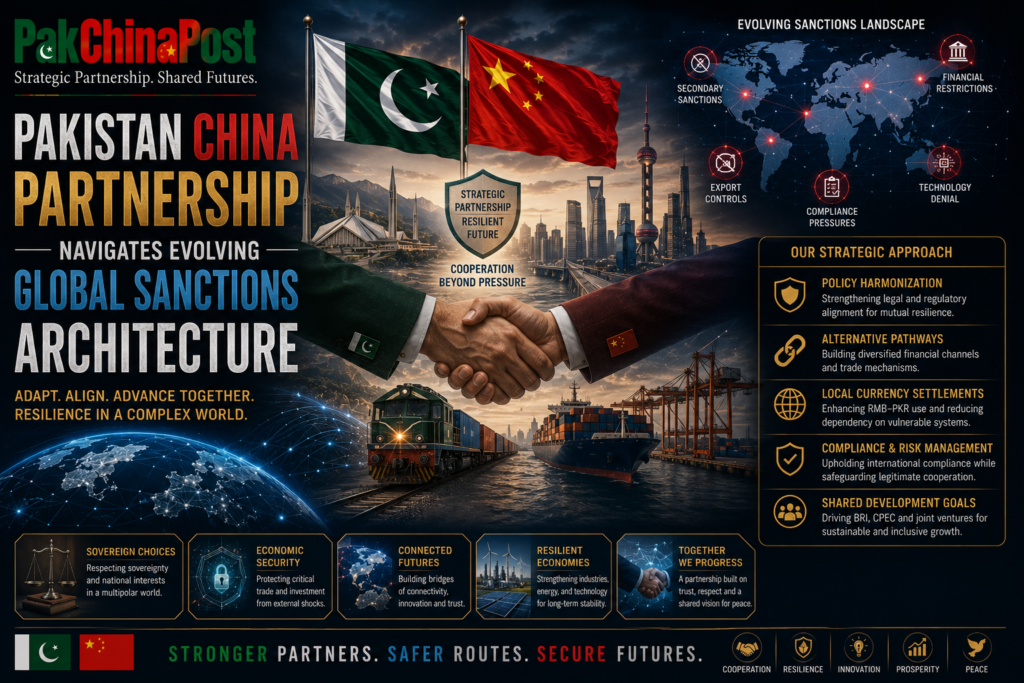
Pakistan China economic cooperation is entering a strategic phase where the defining constraints are no longer confined to conventional security competition or traditional trade barriers. The principal variables increasingly originate from an expanding international sanctions architecture that now combines financial regulation, export controls, technology governance, investment screening, compliance obligations and digital transparency into an integrated framework of economic statecraft. Modern geopolitical competition is progressively exercised through regulatory instruments rather than direct military confrontation. Financial networks, technology ecosystems, banking compliance, industrial standards and cross border investment approvals have become instruments capable of shaping strategic behaviour, influencing national development trajectories and determining the pace of international economic integration.
The transformation represents one of the most profound shifts in international political economy since the end of the Cold War. Economic interdependence was once expected to reduce geopolitical confrontation through expanding commercial interests. Instead, interdependence itself has become a strategic asset. States possessing influence over reserve currencies, payment systems, advanced technologies, semiconductor supply chains, logistics networks and regulatory institutions increasingly employ these advantages to achieve foreign policy objectives without resorting to military coercion. Economic leverage now functions alongside diplomacy as an instrument capable of influencing investment decisions, technology transfers and industrial partnerships across multiple jurisdictions.
For Pakistan and China, this changing environment presents both opportunities and significant institutional responsibilities. Their expanding cooperation under the China Pakistan Economic Corridor, industrial collaboration, digital infrastructure initiatives, energy investments and manufacturing partnerships must increasingly operate within a global regulatory environment that scrutinises financial transactions, ownership structures, procurement systems, technological transfers and corporate governance standards with unprecedented intensity.
International sanctions have evolved considerably beyond traditional embargoes targeting individual governments. Contemporary sanctions regimes incorporate financial restrictions, export licensing requirements, investment prohibitions, technology transfer limitations, maritime compliance standards, beneficial ownership disclosures and sophisticated monitoring systems capable of tracking cross border commercial activities in real time. These mechanisms are reinforced by artificial intelligence assisted compliance technologies, enhanced customs verification, blockchain based trade monitoring and increasingly integrated international reporting standards.
The cumulative impact is creating a regulatory ecosystem where legal compliance increasingly determines commercial competitiveness. Investors now evaluate regulatory certainty alongside labour costs, infrastructure quality and market potential. Manufacturing firms consider sanctions exposure when selecting suppliers. Financial institutions examine compliance risks before facilitating cross border transactions. Technology companies assess export licensing implications before entering new markets. Sovereign investment funds evaluate governance indicators before committing long term capital.
Pakistan therefore confronts a strategic reality requiring a substantial institutional transition. Economic resilience can no longer be measured solely through macroeconomic stability or export growth. It must also be assessed through regulatory credibility, institutional transparency, legal predictability and compliance capacity capable of supporting international commercial confidence.
China’s own experience illustrates the complexity of operating within expanding regulatory competition. Chinese industries have accelerated indigenous innovation, diversified export destinations, strengthened domestic supply chains and invested heavily in technological self reliance in response to external restrictions. While these adjustments have generated new industrial capabilities, they have also highlighted the importance of regulatory adaptation and institutional flexibility in preserving economic momentum.
Pakistan occupies a different strategic position. Rather than confronting technology restrictions directly, it must ensure that its economic partnerships remain sufficiently transparent, legally robust and institutionally credible to avoid unnecessary regulatory complications. This requires governance improvements rather than geopolitical confrontation.
Financial compliance has emerged as perhaps the most influential component of modern economic statecraft. International banking systems increasingly depend upon comprehensive anti money laundering standards, counter terrorism financing regulations, customer due diligence procedures, beneficial ownership disclosures and continuous transaction monitoring. These mechanisms have expanded from financial crime prevention into broader instruments influencing international investment behaviour.
For Pakistan, strengthening financial compliance should not be interpreted as external accommodation but as domestic institutional strengthening. Transparent financial systems reduce corruption opportunities, improve investor confidence, enhance revenue collection and facilitate sustainable economic growth. Strong compliance institutions simultaneously protect national financial sovereignty by reducing vulnerabilities that external actors may otherwise exploit.
Pakistan’s removal from enhanced international financial monitoring demonstrated that institutional reforms can produce tangible diplomatic and economic benefits. Sustaining these improvements requires continuous investment in regulatory capacity rather than temporary compliance motivated by external pressure. Financial governance should become an enduring national capability embedded across public institutions.
Investment screening has similarly become an increasingly important dimension of international economic competition. Governments now evaluate foreign investment not solely through commercial considerations but also through national security assessments, critical infrastructure protection, technology sensitivity and supply chain resilience. Strategic industries including telecommunications, artificial intelligence, energy infrastructure, ports, semiconductors and digital platforms increasingly attract regulatory scrutiny.
Pakistan should anticipate similar trends affecting inbound investment regardless of investor nationality. Instead of perceiving investment screening as an obstacle, Islamabad should establish transparent domestic investment review mechanisms capable of balancing national security considerations with investor confidence. Clear regulatory frameworks reduce uncertainty while protecting strategic national assets.
China Pakistan investment cooperation would benefit from greater regulatory transparency surrounding procurement procedures, environmental assessments, financial disclosures, dispute resolution mechanisms and public accountability. Enhanced transparency would strengthen international confidence without diminishing sovereign decision making authority.
Technology restrictions increasingly represent the most dynamic element of international economic competition. Advanced semiconductors, artificial intelligence applications, quantum computing, aerospace technologies, biotechnology, cybersecurity tools and advanced manufacturing equipment have become subject to expanding export controls across numerous jurisdictions. Technology access now constitutes a strategic resource comparable to energy security during previous decades.
Pakistan cannot afford technological dependence upon a single external ecosystem. Strategic diversification should therefore complement rather than replace existing partnerships. Cooperation with China in research, digital infrastructure, higher education, semiconductor assembly, software development and advanced manufacturing should expand alongside broader engagement with global innovation networks wherever consistent with national interests.
Domestic technological capability ultimately provides the strongest protection against external restrictions. Investment in universities, applied research institutions, industrial innovation centres, vocational education and technology entrepreneurship will determine Pakistan’s long term competitiveness more than temporary policy adjustments responding to evolving sanctions regimes.
Industrial adaptation represents another critical policy priority. Manufacturing competitiveness increasingly depends upon compliance with international environmental standards, digital traceability requirements, labour regulations, cybersecurity certifications and product safety frameworks. Export markets increasingly reward regulatory compliance alongside production efficiency.
Pakistani industries must therefore integrate compliance into production processes rather than treating regulation as an external administrative burden. Export competitiveness increasingly depends upon environmental certification, quality assurance, digital documentation and transparent supply chain management. These standards enhance international market access irrespective of geopolitical developments.
China’s industrial transformation demonstrates that regulatory adaptation and technological upgrading can reinforce rather than undermine manufacturing competitiveness. Pakistan should pursue similar institutional learning while adapting policies to domestic economic realities.
Supply chain resilience has become another defining feature of contemporary economic statecraft. Governments and multinational corporations increasingly diversify suppliers, logistics routes and production locations to reduce strategic vulnerabilities. Pakistan possesses geographical advantages capable of supporting regional supply chain diversification through improved logistics infrastructure, industrial zones, customs modernisation and digital trade facilitation.
However, supply chain participation requires institutional reliability. Delayed customs procedures, inconsistent regulations, inadequate digital systems and unpredictable administrative practices reduce commercial attractiveness regardless of geographical location. Regulatory efficiency has therefore become a strategic economic asset.
Legal preparedness deserves considerably greater policy attention. International commercial disputes increasingly involve sanctions compliance, contractual obligations, investment protections, intellectual property rights, arbitration procedures and digital trade regulations. Pakistan requires specialised legal expertise capable of supporting both government institutions and private sector participants operating within increasingly complex regulatory environments.
Specialised commercial courts, modern arbitration frameworks, digital evidence procedures and internationally recognised dispute resolution mechanisms would significantly improve investor confidence while strengthening domestic governance. Legal modernisation constitutes an economic reform rather than merely a judicial initiative.
Financial transparency similarly requires comprehensive institutional development. Corporate disclosures, public procurement systems, beneficial ownership registries, digital taxation mechanisms and integrated regulatory databases collectively strengthen economic governance while reducing reputational risks. Transparent institutions attract sustainable investment because they reduce uncertainty rather than because they satisfy external expectations.
The expanding role of environmental, social and governance standards further illustrates how regulatory competition increasingly shapes investment decisions. Major institutional investors now evaluate governance quality, climate resilience, labour practices and corporate accountability before allocating capital. Pakistan cannot remain insulated from these evolving investment criteria.
Rather than viewing environmental governance as an externally imposed condition, policymakers should recognise its contribution to industrial competitiveness, export market access and long term economic sustainability. Green industrial policies, renewable energy expansion and responsible resource management increasingly align commercial interests with national development objectives.
Digital governance represents another emerging frontier. Cross border data flows, cybersecurity regulations, digital payment systems, cloud infrastructure and artificial intelligence governance increasingly influence international economic cooperation. Pakistan China digital collaboration should therefore incorporate internationally recognised cybersecurity standards, privacy protections and technical interoperability capable of facilitating broader international engagement.
Cyber resilience deserves particular emphasis because financial systems, industrial infrastructure and government services increasingly depend upon interconnected digital networks. Regulatory compliance alone cannot substitute for operational cybersecurity capabilities. National resilience requires continuous investment in digital infrastructure protection, cyber workforce development and institutional coordination.
Export diversification remains essential for reducing exposure to evolving sanctions environments. Economies dependent upon limited markets or narrow industrial sectors possess fewer options when regulatory conditions change. Pakistan should expand manufacturing exports, technology services, agricultural value addition, pharmaceuticals, engineering products and knowledge based industries across multiple regional markets.
Trade diplomacy should similarly prioritise regulatory dialogue alongside tariff negotiations. Mutual recognition agreements, customs cooperation, standards harmonisation and digital trade frameworks increasingly determine commercial opportunities. Economic diplomacy must therefore integrate technical regulatory expertise alongside traditional diplomatic engagement.
Institutional coordination across government agencies requires substantial improvement. Financial regulators, customs authorities, investment boards, commerce ministries, technology agencies, central banking institutions and national security organisations often operate through fragmented administrative structures. Contemporary economic statecraft demands integrated policy responses because sanctions, technology restrictions and financial regulations frequently overlap across institutional boundaries.
Pakistan should establish a permanent national economic security coordination mechanism responsible for monitoring international regulatory developments, assessing strategic risks, coordinating institutional responses and advising policymakers on emerging compliance challenges. Such an institution would strengthen strategic foresight without centralising operational authority unnecessarily.
For the establishment, economic security should increasingly be understood as an extension of national security rather than a separate policy domain. Strategic competition increasingly targets industrial capabilities, financial resilience, technological innovation and regulatory credibility instead of territorial control alone. National preparedness therefore requires integrated civil military understanding of evolving economic risks.
Strategic infrastructure projects associated with Pakistan China cooperation should incorporate comprehensive compliance assessments during planning rather than after implementation. Environmental impact, financial transparency, procurement integrity, cybersecurity requirements and international legal obligations should become integral components of project governance from inception.
Public communication also deserves greater attention. International narratives frequently shape investor perceptions regardless of underlying economic realities. Transparent reporting, credible data publication and consistent policy communication reduce speculation while strengthening international confidence. Strategic communication should therefore complement regulatory reform.
Academic institutions likewise possess an important role in supporting national preparedness. Universities should expand research on sanctions policy, international financial regulation, technology governance, economic security and commercial diplomacy. Building domestic intellectual capacity reduces dependence upon external policy analysis while strengthening long term institutional resilience.
Private sector participation remains indispensable. Businesses require practical guidance regarding evolving compliance standards, export controls, cybersecurity obligations and international reporting requirements. Government should facilitate public private dialogue supporting regulatory adaptation without imposing excessive administrative burdens upon industry.
Pakistan China cooperation possesses considerable potential precisely because both countries increasingly recognise the importance of industrial development, infrastructure connectivity and long term economic planning. Yet future success will depend less upon the scale of investment than upon governance quality surrounding implementation. Transparent institutions, predictable regulations and internationally credible compliance frameworks enhance rather than weaken sovereign decision making.
The objective should never be strategic isolation from international regulatory evolution. Nor should it involve uncritical acceptance of every emerging external standard. Instead, Pakistan should pursue selective institutional modernisation that protects national interests while expanding international commercial credibility. Sovereign flexibility is strengthened through institutional competence rather than regulatory ambiguity.
The future of international competition will increasingly reward countries capable of combining strategic autonomy with regulatory credibility. Economic resilience will depend upon institutional quality as much as financial resources. Investment attractiveness will reflect governance standards alongside infrastructure development. Diplomatic influence will increasingly derive from economic reliability rather than political declarations.
Pakistan China cooperation enters this evolving landscape with substantial opportunities provided both partners recognise that twenty first century strategic competition increasingly unfolds through financial systems, regulatory institutions, technology ecosystems and governance frameworks rather than conventional military confrontation alone. Pakistan’s comparative advantage will therefore depend upon building institutions capable of navigating complex international regulatory environments while preserving national sovereignty, attracting sustainable investment, protecting strategic industries and reinforcing long term economic resilience. Such preparedness will ultimately determine whether Pakistan emerges as a confident participant in the evolving architecture of global economic statecraft or remains vulnerable to external regulatory shocks that increasingly define international power in the modern era.