

Pakistan China Partnership and the Future of Critical Mineral Sovereignty

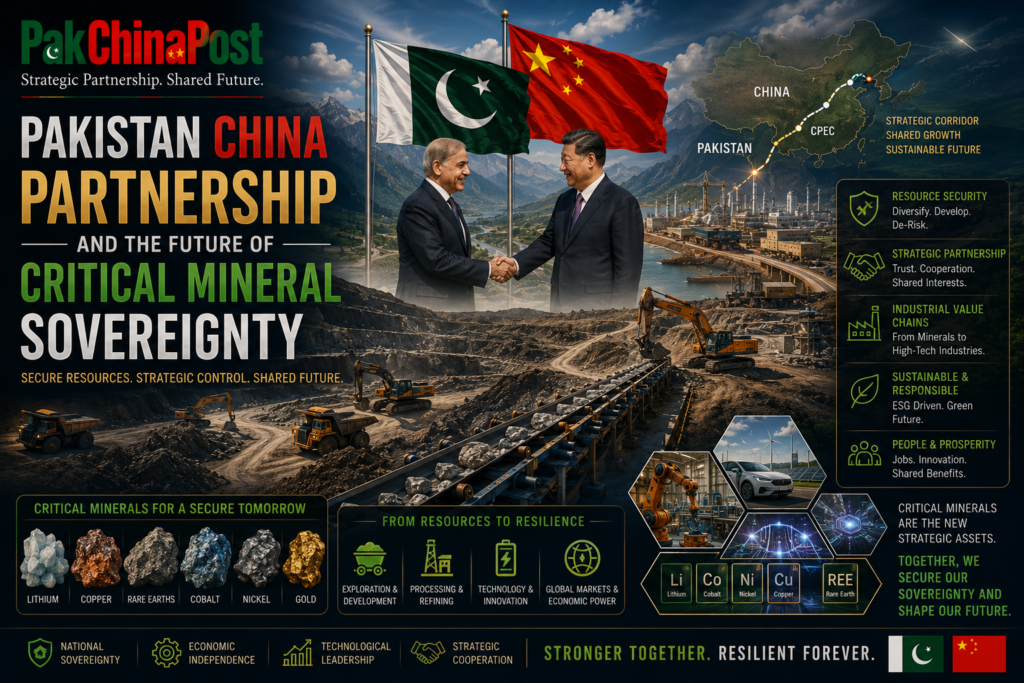
Pakistan and China are entering a new phase of economic cooperation in which strategic value will increasingly be measured not only through transport corridors, industrial parks, and energy connectivity, but also through the capacity to secure, process, and commercialise the critical minerals that underpin advanced manufacturing. As global competition expands beyond conventional industrial production, nations capable of refining rare earth elements, producing battery materials, processing strategic industrial minerals, and supplying high value inputs for emerging technologies are acquiring a decisive geopolitical and economic advantage. This transformation presents Pakistan with an opportunity to reposition itself from being primarily a resource holder into becoming an integrated participant within China’s expanding industrial ecosystem.
The international strategic landscape has shifted from competition over energy resources alone towards competition over the minerals that enable digital economies, clean energy systems, advanced defence platforms, semiconductor production, aerospace technologies, robotics, telecommunications equipment, and electric mobility. Critical minerals are no longer viewed merely as commodities. They have become instruments of economic resilience, technological independence, and national security. Governments across Asia, Europe, North America, and the Global South are restructuring industrial strategies around secure mineral supply chains because manufacturing competitiveness increasingly depends upon uninterrupted access to these specialised resources.
China has spent decades constructing one of the world’s most comprehensive critical mineral ecosystems. Rather than concentrating solely on mining activities, Beijing systematically invested in geological exploration, mineral processing, advanced metallurgy, rare earth separation technologies, chemical refining, manufacturing integration, research institutions, technical education, logistics infrastructure, and export competitiveness. This integrated model has enabled China to dominate several stages of the global value chain, allowing the country to convert mineral resources into sophisticated industrial capabilities rather than relying on raw material exports.
Pakistan’s strategic partnership with China creates favourable conditions for adopting a similar developmental philosophy. The objective should not be limited to extracting minerals for international markets. Instead, national policy should encourage domestic processing, technological upgrading, industrial innovation, and manufacturing integration capable of generating significantly higher economic value. The distinction between exporting raw ore and exporting refined industrial products represents the difference between commodity dependence and industrial sovereignty.
Pakistan possesses considerable geological potential across various strategic minerals including copper, gold, chromite, lithium associated formations, rare earth prospects, industrial clays, gypsum, silica, barite, fluorite, and numerous metallic minerals that remain underexplored. While comprehensive geological surveys continue to improve national understanding of these deposits, the country’s greatest challenge does not lie beneath the ground. The principal challenge lies above ground within institutions, regulatory frameworks, technical capacity, infrastructure, investment governance, and industrial planning.
Historically, many resource rich countries have remained trapped within cycles of low value extraction because insufficient investment was directed towards downstream industries. Raw minerals were exported with limited processing while higher value manufacturing occurred elsewhere. This pattern generated employment abroad, transferred technological knowledge to foreign industries, and restricted domestic industrial diversification. Pakistan possesses an opportunity to avoid this trajectory by embedding mineral development within a comprehensive industrial strategy coordinated closely with Chinese technological capabilities.
China’s industrial transformation increasingly requires diversified and resilient sources of processed minerals capable of supporting expanding sectors including electric vehicles, renewable energy technologies, aerospace engineering, advanced electronics, precision machinery, artificial intelligence infrastructure, and semiconductor manufacturing. Pakistan can contribute to this evolving ecosystem by specialising in selected processing activities that complement Chinese industrial demand while simultaneously expanding domestic manufacturing capacity.
Achieving such integration requires investment in advanced metallurgy rather than conventional mining alone. Modern mineral competitiveness depends upon sophisticated chemical engineering, materials science, metallurgical innovation, automation, laboratory testing, quality certification, and environmental management. Processing technologies determine commercial value far more than extraction itself. Countries that master refining technologies retain greater economic benefits, attract higher quality investment, and establish stronger positions within international industrial supply chains.
Industrial cooperation between Pakistan and China should therefore prioritise the establishment of mineral processing zones adjacent to major mining regions. These zones could integrate refining facilities, metallurgical laboratories, engineering workshops, logistics centres, environmental monitoring systems, vocational institutes, and industrial research partnerships. Concentrating complementary industries within specialised clusters would reduce production costs while encouraging technological spillovers between enterprises.
Investment confidence represents another essential pillar of mineral competitiveness. Large scale refining facilities require substantial capital commitments extending over several decades. Investors seek predictable regulations, transparent licensing procedures, legal certainty, contractual stability, efficient dispute resolution mechanisms, and professional public administration. Frequent policy reversals or administrative uncertainty discourage investment precisely when long term industrial commitments become necessary.
Pakistan should therefore pursue regulatory consistency through comprehensive mineral governance reforms that simplify administrative procedures while strengthening institutional accountability. Digital licensing systems, transparent concession management, integrated geological databases, independent regulatory oversight, and internationally recognised reporting standards would significantly enhance investor confidence without compromising national interests.
Environmental governance must occupy a central position within future mineral development strategies. Global manufacturers increasingly evaluate environmental performance throughout supply chains before establishing procurement relationships. International markets increasingly demand evidence of responsible mining practices, carbon management, water conservation, biodiversity protection, waste recycling, occupational safety, and community engagement. Environmental responsibility has therefore evolved into a competitive economic asset rather than solely a regulatory obligation.
China has accumulated substantial experience in improving environmental performance across industrial sectors while simultaneously expanding manufacturing capacity. Joint Pakistan China research initiatives could adapt cleaner processing technologies suitable for local geological conditions. Modern waste treatment systems, water recycling facilities, emissions control technologies, renewable energy integration, and environmental monitoring platforms should become standard components of future mineral projects rather than subsequent additions.
Mineral certification represents another increasingly important dimension of international competitiveness. Advanced manufacturers require confidence regarding origin, quality, sustainability, traceability, and ethical production standards before incorporating minerals into global supply chains. Certification systems strengthen market credibility while reducing commercial uncertainty. Pakistan should establish internationally recognised certification institutions capable of verifying mineral quality, environmental compliance, laboratory testing, processing standards, and export specifications.
Academic institutions also possess an essential role within this industrial transformation. Universities should expand programmes in metallurgy, materials engineering, mineral economics, industrial chemistry, geological modelling, environmental science, automation engineering, and advanced manufacturing. Joint research centres with Chinese universities could accelerate knowledge transfer while producing specialised technical professionals capable of supporting domestic industrial expansion.
Vocational education deserves equal attention. Advanced mineral processing requires technicians skilled in laboratory operations, industrial automation, heavy machinery maintenance, precision manufacturing, quality assurance, process engineering, environmental monitoring, and industrial safety. Establishing specialised technical institutes within mineral producing regions would strengthen local employment while reducing dependence upon imported expertise.
Innovation should become the defining characteristic of Pakistan’s mineral strategy rather than simple resource extraction. Research institutions should encourage development of improved refining techniques, recycling technologies, advanced materials, battery chemistry, industrial ceramics, specialised alloys, composite materials, and mineral based manufacturing applications. Industrial innovation enables countries to capture substantially greater economic value than exporting primary commodities.
Small and medium enterprises can contribute significantly to this innovation ecosystem by supplying engineering services, industrial equipment, laboratory technologies, maintenance operations, environmental solutions, logistics support, software systems, and specialised manufacturing inputs. Policies encouraging domestic entrepreneurship alongside large scale industrial investment would create broader economic participation while strengthening supply chain resilience.
Financial institutions should also develop specialised investment mechanisms tailored to mineral processing industries. Long term financing, industrial development funds, export credit facilities, technology upgrading programmes, and research grants would reduce investment barriers facing domestic enterprises seeking participation within advanced manufacturing sectors.
Digital technologies are becoming increasingly integrated into mineral industries. Artificial intelligence supports geological exploration, predictive maintenance, process optimisation, resource modelling, quality control, logistics management, and environmental monitoring. Industrial digitalisation enhances productivity while improving operational efficiency. Pakistan should incorporate digital transformation into future mining and processing policies from the outset rather than treating technology adoption as a secondary objective.
Infrastructure planning should extend beyond transportation alone. Reliable electricity, renewable energy integration, industrial water supply, digital communications, laboratory infrastructure, hazardous waste management, secure logistics, and specialised industrial estates all contribute directly to mineral competitiveness. Coordinated infrastructure planning between federal authorities, provincial governments, and industrial investors would improve operational efficiency while reducing project costs.
Regional economic diplomacy also presents important opportunities. Pakistan’s geographical position enables connectivity between South Asia, Central Asia, Western China, and the Arabian Sea. Mineral processing industries located within integrated logistics corridors could serve multiple regional markets while strengthening Pakistan’s role as an industrial bridge connecting diverse economic regions.
Industrial cooperation under the framework of the China Pakistan Economic Corridor can therefore evolve beyond infrastructure construction towards advanced manufacturing collaboration. Future cooperation may increasingly focus upon technology transfer, industrial research, materials engineering, specialised manufacturing, innovation financing, professional training, and integrated production networks. Such evolution would deepen economic cooperation while supporting industrial diversification in both countries.
Government institutions should establish a comprehensive National Critical Minerals Strategy integrating geological exploration, industrial development, environmental governance, research investment, export promotion, technological cooperation, human capital development, and international market engagement within a single policy framework. Fragmented institutional responsibilities frequently undermine long term industrial planning. Coordinated governance structures would improve policy implementation while encouraging investor confidence.
Strategic communication also matters. International investors, manufacturers, financial institutions, and technology partners require clear understanding of Pakistan’s long term industrial vision. Transparent policy objectives, measurable implementation milestones, regular public reporting, and consistent regulatory communication strengthen international credibility while attracting higher quality industrial partnerships.
Pakistan’s comparative advantage should not depend solely upon possessing mineral resources. Sustainable competitiveness will emerge from the ability to transform those resources into technologically sophisticated products integrated within international manufacturing systems. Countries generating greater value from each tonne of extracted material will possess stronger industrial resilience than those exporting unprocessed commodities.
The Pakistan China partnership provides an exceptional platform for pursuing this transformation because both countries share complementary economic interests. China continues expanding advanced manufacturing capabilities requiring secure mineral inputs, while Pakistan seeks industrial diversification capable of generating employment, technological advancement, export growth, and economic resilience. Aligning these objectives through value added mineral industries offers substantial long term benefits for both partners.
Future industrial influence will increasingly belong to countries capable of combining resource security with technological capability, environmental responsibility, institutional credibility, manufacturing excellence, and continuous innovation. Pakistan should therefore prioritise five practical strategies. First, establish integrated mineral processing and metallurgy clusters linked with Chinese industrial cooperation. Second, modernise regulatory institutions through transparent digital governance and internationally recognised certification systems. Third, invest heavily in research universities, technical education, and industrial innovation focused on advanced materials and refining technologies. Fourth, implement rigorous environmental governance that strengthens international market confidence while protecting natural ecosystems. Fifth, integrate critical mineral development within national industrial policy so that resource extraction consistently supports higher value manufacturing, export competitiveness, and technological self reliance. Through these reforms, Pakistan can evolve from a supplier of raw minerals into a trusted producer of advanced industrial materials, reinforcing its position within China’s evolving industrial ecosystem while building a globally competitive critical minerals economy capable of sustaining long term national prosperity.
A Public Service Message


