Artificial Intelligence Disinformation During Regional Crises

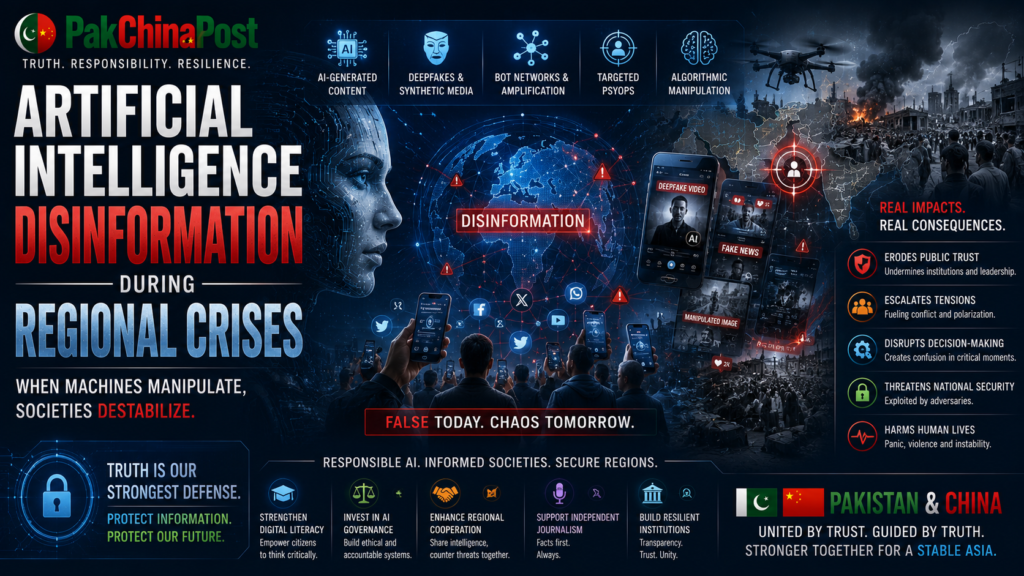
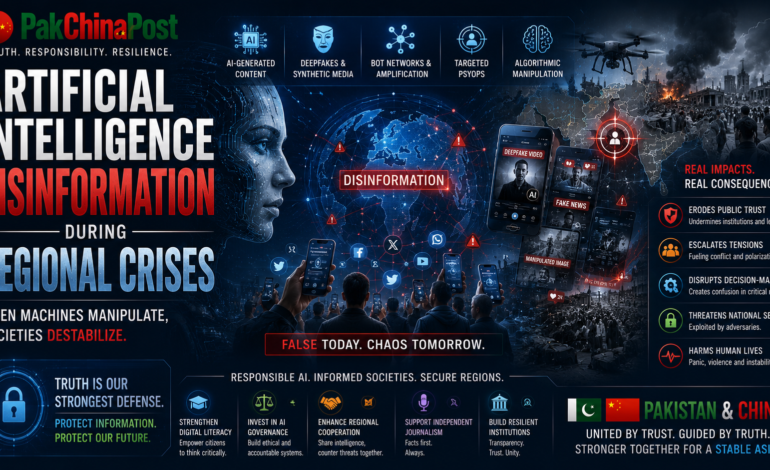
Pak China strategic cooperation increasingly confronts an emerging security variable that receives far less institutional attention than missiles, sanctions or military deployments. Artificial intelligence generated disinformation has evolved into a sophisticated instrument capable of reshaping diplomatic calculations, disrupting crisis management and manipulating strategic perceptions before governments can establish verified situational awareness. Unlike conventional propaganda campaigns requiring extensive human coordination, generative artificial intelligence now enables the industrial production of convincing synthetic narratives, fabricated official statements, multilingual influence operations, cloned voices, manipulated battlefield imagery and entirely fictional diplomatic exchanges at unprecedented speed. During periods of heightened regional tension, information itself has become a contested operational theatre where fabricated realities can influence political decision making as decisively as physical military capabilities. For Pakistan and China, whose strategic partnership increasingly attracts international attention across diplomatic, economic and security domains, institutional preparedness against artificial intelligence enabled information warfare has become an essential component of national resilience rather than merely a communication challenge.
The defining characteristic of artificial intelligence disinformation lies not only in its technical sophistication but also in its capacity to compress decision making timelines. Traditional misinformation campaigns allowed governments hours or days to investigate manipulated content before it significantly influenced public opinion or international diplomacy. Contemporary generative systems can manufacture thousands of highly credible digital assets within minutes, adapting narratives across languages, cultural contexts and demographic audiences with remarkable precision. Crisis managers therefore confront a fundamentally altered information environment where fabricated evidence may circulate globally before intelligence agencies complete initial verification procedures. Diplomatic institutions historically designed around measured communication cycles now operate within a digital ecosystem dominated by algorithmic amplification and instantaneous emotional engagement.
Military crises represent particularly vulnerable environments because uncertainty naturally creates information vacuums. Whenever governments temporarily withhold operational details for security reasons, artificial intelligence systems rapidly populate digital platforms with fabricated explanations, counterfeit military announcements, fictional casualty figures and manipulated satellite imagery. These synthetic narratives often appear technically convincing because generative models imitate official communication styles, military terminology and institutional branding with increasing accuracy. The distinction between authentic governmental communication and fabricated content consequently becomes progressively blurred, creating confusion among domestic populations, international observers and even allied governments attempting to interpret unfolding developments.
Pak China cooperation introduces additional complexity because both countries operate across multiple linguistic, technological and diplomatic ecosystems. Artificial intelligence platforms capable of simultaneously generating persuasive narratives in English, Mandarin, Urdu, Arabic and numerous regional languages significantly expand the operational reach of hostile influence campaigns. Adversarial actors no longer require specialised regional expertise. Machine learning models increasingly perform cultural adaptation automatically, adjusting vocabulary, historical references and political framing according to targeted audiences. Consequently, identical fabricated incidents may be presented differently to Western policymakers, Pakistani citizens, Chinese social media users and international financial markets, creating fragmented perceptions of identical events.
The convergence of artificial intelligence with automated social media infrastructures has transformed influence operations from episodic campaigns into continuously adaptive ecosystems. Machine generated accounts equipped with advanced language models can sustain apparently authentic political conversations, respond dynamically to emerging events and coordinate narrative reinforcement without direct human supervision. Rather than relying upon isolated fabricated stories, modern influence architectures gradually cultivate credibility before introducing strategically timed disinformation during geopolitical crises. Such persistent digital presence complicates detection because automated accounts increasingly mimic ordinary behavioural patterns, emotional expression and conversational inconsistencies associated with genuine human interaction.
Emergency communication systems remain particularly exposed because institutional verification mechanisms generally prioritise factual accuracy over communication velocity. Governments understandably hesitate before releasing sensitive information during military incidents, terrorist attacks or diplomatic confrontations. Artificial intelligence exploits this institutional caution by rapidly occupying informational space with fabricated narratives designed to establish initial public perceptions. Psychological research consistently demonstrates that early information frequently shapes enduring public beliefs even after subsequent corrections emerge. Consequently, governments responding slowly with verified information often struggle to reverse narratives already embedded across digital ecosystems.
Another vulnerability concerns institutional dependence upon visual evidence. Modern policymaking increasingly relies upon photographs, satellite imagery, surveillance recordings and video documentation supporting operational assessments. Generative artificial intelligence now produces synthetic visual material sufficiently convincing to deceive non specialist observers and occasionally sophisticated analytical systems. Fabricated footage depicting military mobilisation, border incidents, infrastructure damage or diplomatic meetings may influence international responses before technical authentication procedures identify manipulation. During rapidly evolving crises, such temporal advantages may generate substantial strategic consequences irrespective of subsequent exposure.
Financial markets constitute another strategic target because artificial intelligence enabled disinformation increasingly intersects with economic statecraft. Fabricated announcements concerning sanctions, sovereign debt, critical infrastructure disruption, currency restrictions or trade embargoes can generate immediate market volatility affecting investor confidence and capital flows. Pakistan’s economic reform trajectory and China’s expanding international commercial networks both depend upon predictable information environments. Coordinated synthetic narratives targeting financial credibility therefore possess geopolitical significance extending beyond ordinary misinformation. Digital deception increasingly functions as an indirect economic pressure mechanism capable of imposing substantial costs without conventional military confrontation.
Critical infrastructure operators similarly confront expanding informational risks. Electricity grids, telecommunications networks, transportation systems and logistics corridors increasingly depend upon public confidence during operational disruptions. Artificial intelligence generated announcements falsely claiming infrastructure collapse, cyber intrusions or contamination incidents may provoke unnecessary panic, commercial disruption and emergency resource diversion. Such campaigns become particularly effective when synchronised with genuine technical failures, natural disasters or security incidents, thereby amplifying confusion while complicating institutional response.
The diplomatic consequences extend equally across international institutions. Artificial intelligence systems can fabricate transcripts of confidential negotiations, counterfeit official correspondence or manipulate recordings of diplomatic conversations. Such synthetic material may undermine fragile negotiations, erode trust between strategic partners and complicate multilateral crisis management. Diplomatic credibility traditionally depends upon confidence that official communications remain authentic. Artificial intelligence increasingly challenges this foundational assumption, compelling governments to reconsider authentication procedures throughout international engagement.
Pakistan’s institutional landscape reflects both important strengths and significant vulnerabilities. Military communication structures maintain comparatively disciplined operational procedures during national security incidents. However, civilian agencies responsible for emergency communication, provincial coordination, digital regulation and public information frequently operate through fragmented institutional mandates. Multiple authorities share overlapping responsibilities without unified operational protocols governing artificial intelligence related information crises. Consequently, response mechanisms often remain reactive rather than anticipatory, allowing fabricated narratives valuable opportunities to proliferate before coordinated institutional engagement begins.
China possesses substantially greater technological capabilities supporting artificial intelligence governance, cyber monitoring and digital platform regulation. Nevertheless, technological capacity alone cannot guarantee informational resilience. Increasing sophistication among generative systems continuously challenges detection technologies, while international digital ecosystems extend beyond domestic regulatory jurisdiction. Chinese institutions therefore confront strategic requirements balancing technological innovation, information governance and international credibility without creating excessive restrictions upon legitimate scientific development or commercial artificial intelligence applications.
Pak China cooperation presents significant opportunities precisely because their institutional strengths differ. China’s comparative advantage in artificial intelligence research, computational infrastructure and digital governance complements Pakistan’s strategic experience confronting hybrid security challenges, counterterrorism communication and complex regional information environments. Bilateral collaboration could therefore produce integrated frameworks exceeding capabilities either country might independently achieve. Information integrity increasingly requires multinational institutional cooperation because influence campaigns routinely traverse national jurisdictions, cloud infrastructures and multilingual digital platforms beyond unilateral regulatory reach.
Existing international regulatory approaches remain insufficiently adapted to generative artificial intelligence. Many legislative frameworks continue addressing misinformation primarily through content moderation, platform accountability and user reporting mechanisms developed before contemporary generative technologies emerged. Artificial intelligence fundamentally alters operational dynamics by dramatically increasing production scale, reducing technical barriers and enabling personalised narrative generation. Regulatory institutions consequently struggle to maintain relevance because legislative processes advance considerably slower than technological innovation cycles.
Democratic societies confront particularly delicate policy dilemmas. Excessively restrictive information governance risks undermining civil liberties, academic freedom and legitimate political discourse. Insufficient regulation meanwhile enables increasingly sophisticated manipulation threatening democratic decision making itself. Effective governance therefore requires institutional precision distinguishing malicious synthetic deception from legitimate artificial intelligence innovation. Blanket prohibitions rarely prove operationally sustainable because generative technologies increasingly permeate education, healthcare, commerce, scientific research and creative industries alongside security concerns.
Technology companies similarly occupy an increasingly strategic position within national security architectures. Digital platforms originally designed primarily around commercial objectives now perform quasi public functions influencing political communication, emergency information dissemination and societal resilience. Yet commercial incentives frequently prioritise user engagement over information authenticity. Algorithmic recommendation systems may unintentionally amplify emotionally provocative synthetic content because engagement metrics reward sensational narratives irrespective of factual reliability. Policymakers therefore confront growing pressure to redefine platform responsibilities during national emergencies without undermining innovation or market competition.
Artificial intelligence detection technologies continue improving, although adversarial adaptation proceeds simultaneously. Watermarking systems, cryptographic authentication protocols, provenance verification frameworks and forensic analysis tools offer promising defensive capabilities. Nevertheless, determined actors consistently develop techniques circumventing existing safeguards. Information security therefore increasingly resembles broader cybersecurity dynamics where permanent technological competition replaces expectations of definitive solutions. Institutional resilience consequently depends upon continuous adaptation rather than static regulatory compliance.
Public sector workforce development represents another overlooked dimension. Crisis communication officials, intelligence analysts, diplomats, journalists, emergency managers and judicial authorities increasingly require specialised competencies recognising artificial intelligence generated deception. Traditional media literacy programmes insufficiently address sophisticated synthetic media capable of deceiving experienced professionals. Institutional education must therefore evolve beyond general awareness toward operational expertise incorporating digital forensics, behavioural analytics and algorithmic risk assessment.
Strategic intelligence agencies likewise require doctrinal evolution. Conventional intelligence methodologies primarily evaluate physical capabilities, political intentions and military deployments. Artificial intelligence enabled influence architectures demand expanded analytical frameworks integrating computational propaganda, behavioural manipulation and algorithmic amplification into national threat assessments. Information warfare can no longer remain conceptually separated from conventional strategic intelligence because both increasingly interact throughout contemporary geopolitical competition.
Military establishments also confront operational implications extending beyond public communication. Battlefield command increasingly depends upon digital information systems vulnerable not merely to technical intrusion but also cognitive manipulation. Artificial intelligence generated deception targeting commanders, operational planners or coalition partners may distort situational awareness without compromising underlying technological infrastructure. Defensive doctrine must therefore integrate cognitive security alongside cyber defence, electronic warfare and traditional intelligence disciplines.
Academic institutions possess equally significant responsibilities supporting evidence based policymaking. Independent research evaluating artificial intelligence disinformation trends, behavioural impacts and technological vulnerabilities remains indispensable for effective governance. Pakistan and China could substantially strengthen bilateral resilience through joint research centres combining computational science, behavioural psychology, strategic studies, communication research and public policy expertise. Such multidisciplinary collaboration would generate empirically grounded recommendations supporting adaptive institutional development rather than reactive regulatory improvisation.
Regional organisations similarly require expanded mandates addressing information integrity during cross border crises. Existing security dialogues generally prioritise military confidence building, counterterrorism coordination and economic cooperation while devoting comparatively limited attention to artificial intelligence enabled influence operations. Dedicated regional protocols governing emergency verification, coordinated public communication and technical information exchange would substantially reduce opportunities for adversarial narrative manipulation exploiting institutional fragmentation.
An effective preparedness architecture should therefore rest upon several mutually reinforcing institutional pillars rather than isolated technological interventions. Pakistan and China should establish a permanent bilateral Artificial Intelligence Information Integrity Coordination Centre integrating strategic communication specialists, cybersecurity experts, intelligence professionals, digital forensic analysts and emergency management authorities operating through continuously updated crisis protocols. This institution should maintain secure verification channels enabling immediate authentication of sensitive governmental communications during rapidly evolving regional developments.
Parallel investment should establish joint synthetic media forensic laboratories capable of developing indigenous detection technologies rather than relying exclusively upon imported commercial platforms. Domestic analytical capability strengthens technological sovereignty while enabling adaptation according to regional linguistic characteristics, geopolitical requirements and operational realities frequently overlooked within externally developed software ecosystems.
National crisis management frameworks should incorporate mandatory information integrity cells operating alongside conventional emergency response structures. These specialised units would continuously monitor digital ecosystems, coordinate interagency verification procedures, engage technology companies and provide authenticated public communication throughout national emergencies. Institutionalising such capabilities prevents ad hoc coordination under crisis conditions where decision making time becomes severely constrained.
Legislative reform should emphasise accountability for malicious synthetic deception targeting national security while carefully protecting legitimate journalism, academic inquiry and responsible artificial intelligence innovation. Regulatory precision rather than expansive prohibition offers greater long term sustainability because technological evolution will inevitably outpace rigid statutory frameworks. Adaptive regulatory mechanisms supported by periodic technical review better accommodate continuing innovation.
Pak China should further advocate international standards promoting authenticated governmental communication through interoperable digital signature protocols recognised across diplomatic networks. Establishing universally verifiable authenticity mechanisms would substantially reduce opportunities for fabricated official announcements undermining crisis diplomacy. Such initiatives could strengthen broader international confidence without imposing unnecessary restrictions upon legitimate digital communication.
Institutional partnerships with responsible technology developers should expand beyond compliance oriented regulation toward collaborative resilience building. Governments require access to advanced analytical capabilities while private sector innovators benefit from structured engagement concerning evolving national security requirements. Transparent public private partnerships therefore represent strategic investments strengthening both technological competitiveness and societal resilience.
Ultimately, artificial intelligence disinformation should no longer be regarded merely as an extension of conventional propaganda. It represents a transformational strategic capability reshaping crisis stability, diplomatic credibility, economic confidence and national security decision making. The defining contest will not revolve solely around computational superiority but around institutional adaptability. Governments capable of integrating technological innovation, strategic intelligence, democratic legitimacy and operational coordination into coherent information resilience architectures will possess substantial strategic advantages within increasingly contested digital environments.
For Pakistan and China, the challenge extends beyond protecting individual narratives or defending isolated communication platforms. Their broader objective must involve constructing resilient institutions capable of preserving informational integrity under conditions deliberately engineered to maximise uncertainty, accelerate decision making and fragment public confidence. Strategic preparedness therefore requires recognising that future regional crises will unfold simultaneously across physical frontiers, cyber infrastructures and cognitive domains. Nations prepared to authenticate reality faster than adversaries manufacture deception will increasingly shape diplomatic outcomes, preserve strategic stability and reinforce national resilience within an international system where information has become both the battlefield and the decisive instrument of statecraft.
A Public Service Message