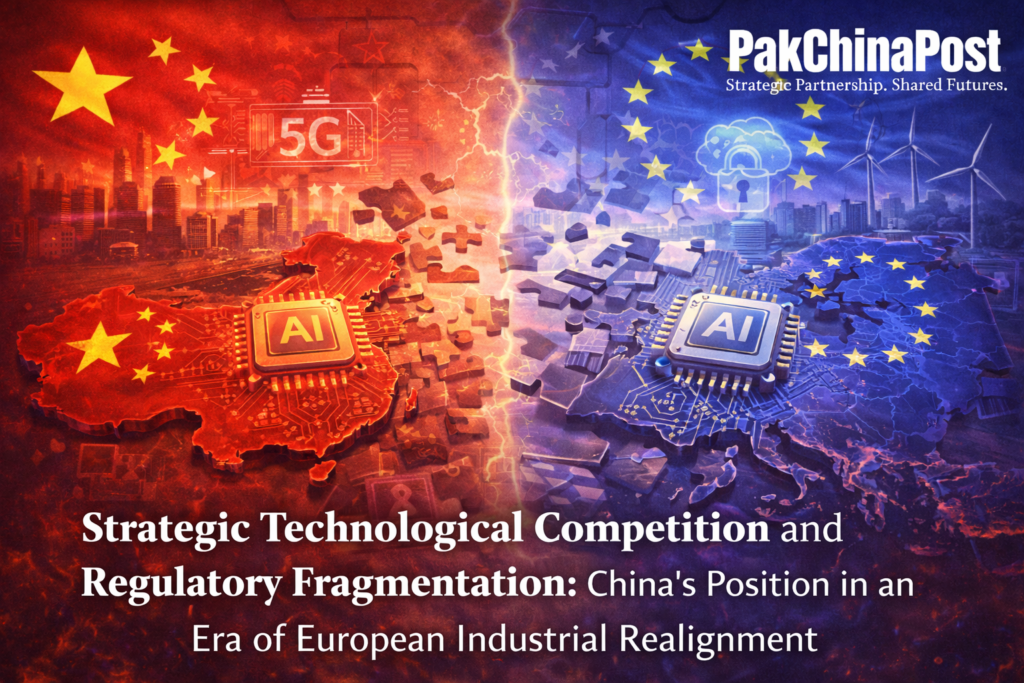
Strategic Technological Competition and Regulatory Fragmentation: China’s Position in an Era of European Industrial Realignment

Technological competition between China and the European Union has entered a structurally transformative phase. No longer confined to commercial rivalry, it now intersects with regulatory sovereignty, security doctrines, industrial policy, and geopolitical alignment. For Chinese diplomats navigating bilateral relations, technological competition with Europe presents a dual reality: significant opportunity for sustained engagement within a sophisticated market, and equally significant constraint generated by regulatory scrutiny, strategic protectionism, and political caution. The strategic challenge is therefore not merely to defend market access, but to safeguard innovation ecosystems, protect intellectual capital, and preserve technological leadership while mitigating reputational and geopolitical risks.
Europe’s technological landscape differs fundamentally from other major actors. Unlike the United States, which emphasizes extraterritorial export controls and unilateral sanctions, the European Union operates through layered regulatory instruments, internal consensus-building, and normative governance frameworks. European decision-making is shaped by competition policy, data protection regimes, digital sovereignty discourse, and a precautionary security culture. China’s engagement with this environment requires calibrated adaptation rather than reactive confrontation.
The 5G telecommunications sector illustrates the complexity of this competitive terrain. Chinese firms achieved early global leadership in 5G infrastructure deployment through extensive R&D investment, scale efficiencies, and cost competitiveness. However, security concerns intensified by transatlantic political dynamics led several European member states to restrict or exclude Chinese vendors from core network infrastructure. While not uniform across the Union, these measures significantly constrained market penetration.
The implications extend beyond immediate commercial loss. Exclusion from European 5G networks affects reputational credibility, long-term service contracts, and standard-setting influence. Telecommunications infrastructure shapes future digital ecosystems; participation determines the architecture within which next-generation applications operate. Thus, regulatory barriers in this domain reverberate through broader digital competitiveness.
Semiconductors constitute an even more strategically sensitive sector. Europe seeks to expand domestic semiconductor production capacity through initiatives such as the European Chips Act, motivated by supply disruptions and geopolitical risk awareness. Although Europe remains dependent on external suppliers for advanced fabrication, it aims to reduce vulnerability and strengthen technological sovereignty. Chinese firms face heightened scrutiny regarding investment in semiconductor facilities, access to advanced lithography equipment, and collaboration with European research institutions.
Protectionist measures whether framed as investment screening, export control coordination, or national security review create friction for China’s global technology integration strategy. Yet the European approach remains nuanced. Unlike outright embargoes, EU policies often permit participation under compliance conditions. This regulatory conditionality creates space for diplomatic engagement and technical negotiation.
Digital infrastructure and data governance represent additional arenas of contestation. The European Union’s General Data Protection Regulation (GDPR) and Digital Markets Act (DMA) reflect a robust regulatory identity emphasizing privacy, competition fairness, and platform accountability. Chinese technology firms operating in Europe must adapt to these norms. Compliance entails cost, but also confers legitimacy and integration into one of the world’s most influential regulatory jurisdictions.
The strategic question for China is how to preserve technological leadership amid these constraints. Several interrelated policy options merit consideration.
First, innovation autonomy must be consolidated domestically. Sustained investment in foundational research particularly in semiconductor design, advanced materials, artificial intelligence, and quantum technologies reduces exposure to external restriction. Indigenous innovation is not merely defensive; it enhances negotiating leverage by positioning China as an indispensable partner rather than a dependent participant.
Second, intellectual property (IP) protection frameworks require continuous strengthening. European stakeholders frequently cite concerns regarding IP security and state involvement. Transparent legal enforcement, specialized IP courts, and bilateral dispute resolution mechanisms can mitigate distrust. Protecting foreign IP within China simultaneously reinforces credibility in advocating reciprocal treatment abroad.
Third, market localization strategies can alleviate political resistance. Establishing research centers, joint ventures, and manufacturing facilities within EU member states integrates Chinese firms into local employment ecosystems. When technology partnerships generate tangible domestic economic benefits, political narratives shift from threat perception to economic pragmatism.
Fourth, standards diplomacy must be prioritized. Technological competition increasingly unfolds within international standard-setting bodies. Active participation in shaping technical norms for 6G, battery safety, artificial intelligence ethics, and cybersecurity protocols ensures that Chinese innovations remain compatible with global frameworks. Alignment reduces fragmentation and prevents technological bifurcation.
Fifth, strategic communication is indispensable. Security anxieties often arise from opacity rather than evidence. Transparent governance structures, independent audits, and cooperative cybersecurity verification processes can address perceived vulnerabilities. Diplomatic channels should emphasize evidence-based dialogue over ideological polarization.
The reputational dimension warrants particular attention. European public opinion exerts meaningful influence over regulatory trajectories. Media narratives, parliamentary debates, and civil society advocacy shape policy outcomes. China’s technological presence must therefore be accompanied by visible commitments to sustainability, data protection, and corporate responsibility.
Despite constraints, opportunities persist. Europe’s green and digital transitions create sustained demand for innovation in electric mobility, energy storage, smart grids, and digital connectivity. Chinese firms possess competitive advantages in battery production, renewable energy integration, and infrastructure deployment. Collaborative research initiatives in climate technology and digital public goods offer pathways for constructive engagement even amid strategic competition.
Furthermore, Europe’s industrial ecosystem values reliability and long-term partnership. Unlike purely transactional markets, the EU emphasizes regulatory compliance and contractual stability. Firms that demonstrate consistent adherence to European standards can secure durable market positions despite geopolitical turbulence.
Risk scenarios must nevertheless be evaluated. In a moderate competition scenario, regulatory scrutiny persists but remains bounded, permitting continued Chinese participation under stricter compliance regimes. In an escalation scenario, coordination with transatlantic export control policies intensifies, restricting technology flows and investment channels. In a fragmentation scenario, divergent digital ecosystems emerge, compelling companies to operate within bifurcated technological spheres.
China’s optimal strategy seeks to anchor relations in the first scenario. This requires avoiding retaliatory escalation, engaging constructively in regulatory dialogue, and reinforcing domestic innovation capacity. Technological leadership cannot rely solely on scale; it must integrate quality, transparency, and normative compatibility.
It is also essential to distinguish between political rhetoric and institutional practice. European policymakers often articulate concerns regarding “strategic dependency,” yet they simultaneously prioritize competitiveness and climate objectives. Where Chinese technologies demonstrably advance European policy goals such as accelerating decarbonization pragmatism tends to moderate exclusionary impulses.
Long-term competitiveness will depend on ecosystem resilience. Diversified export markets, robust domestic demand, and flexible supply chains provide buffers against regulatory shocks. Simultaneously, continued participation in European research programs and academic exchange where feasible sustains knowledge circulation that benefits both sides.
In conclusion, technological competition between China and the European Union is not a zero-sum confrontation but a structured rivalry embedded within deep economic interdependence. Regulatory pushback, market restrictions, and security scrutiny present genuine obstacles to China’s global leadership ambitions. Yet these challenges also catalyze institutional strengthening, innovation autonomy, and strategic diplomacy. By combining domestic technological advancement with calibrated engagement, transparent governance, and standards participation, China can defend its competitive edge while mitigating geopolitical friction. In an era defined by digital sovereignty and industrial recalibration, strategic patience and adaptive modernization will determine whether technological competition evolves into fragmentation or remains anchored in managed interdependence.
A Public Service Message