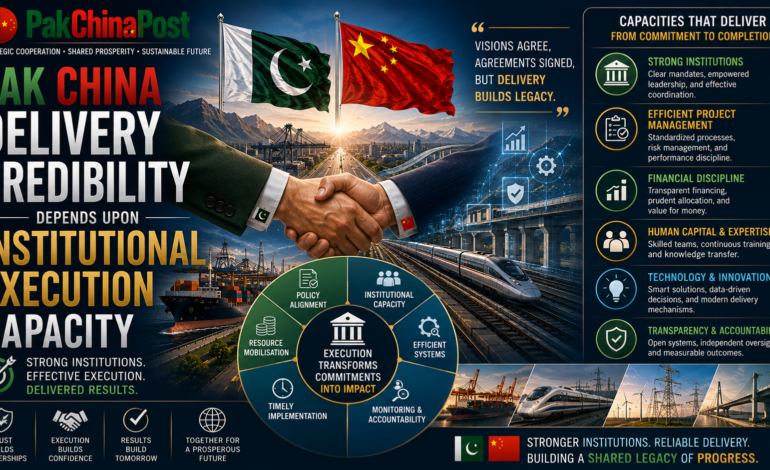
Pak China Delivery Credibility Depends Upon Institutional Execution Capacity

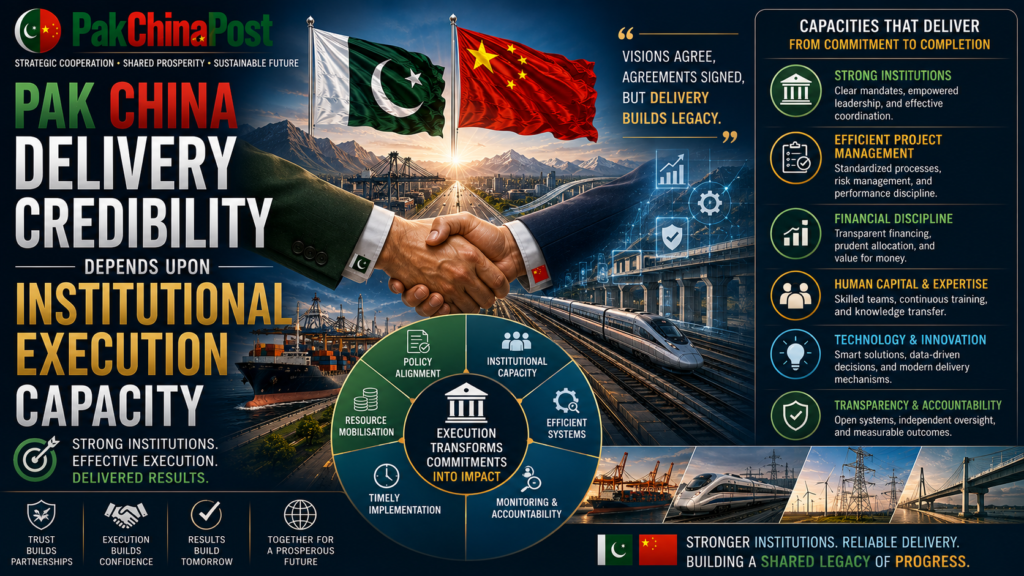
Pak China cooperation is entering a phase where the political value of announcing ambitious projects is steadily being eclipsed by the strategic significance of delivering them with measurable precision. Across the contemporary international investment environment, infrastructure diplomacy is no longer judged by ceremonial ground breakings, memoranda of understanding or headline investment commitments. Strategic partners, sovereign lenders, multinational contractors and financial institutions increasingly measure credibility through implementation discipline, regulatory predictability and institutional competence. Within this evolving framework, Pakistan’s long term strategic standing is becoming inseparable from its ability to transform approved initiatives into operational assets according to agreed schedules, transparent governance standards and demonstrable public value. For Islamabad, the decisive question is no longer whether transformative projects can be announced. The more consequential challenge is whether state institutions possess sufficient administrative capacity to execute them consistently across changing political cycles, fiscal pressures and bureaucratic transitions.
This evolution represents a broader transformation in international development governance. The global marketplace for infrastructure finance has become considerably more discerning following years of uneven project performance across multiple regions. Investors increasingly distinguish between governments capable of sustaining implementation momentum and those that repeatedly encounter administrative bottlenecks after political commitments have already been made. In this environment, implementation itself has become a strategic asset. Countries demonstrating reliable execution attract greater financial confidence, lower sovereign risk perceptions and stronger institutional partnerships than those possessing comparable investment opportunities but weaker delivery mechanisms.
For Pakistan and China, this reality carries particular significance because bilateral cooperation extends beyond conventional economic engagement. The relationship increasingly represents an integrated strategic partnership encompassing industrial development, transport connectivity, energy security, digital infrastructure, scientific cooperation and regional stability. Consequently, every delayed industrial zone, postponed transmission network, incomplete logistics facility or deferred regulatory approval carries implications extending beyond domestic administration. Implementation outcomes increasingly shape diplomatic confidence, commercial calculations and long term strategic expectations within one of Asia’s most consequential bilateral relationships.
Execution capacity is emerging as a national security consideration rather than merely an administrative concern. Modern strategic competition increasingly rewards governments capable of integrating political decision making with institutional coordination, financial discipline and operational management. Military readiness, economic resilience, technological competitiveness and diplomatic influence all depend upon bureaucratic systems capable of translating policy intentions into practical outcomes. Infrastructure projects therefore represent visible indicators of broader state effectiveness. International partners inevitably assess whether successful project implementation reflects deeper institutional maturity capable of supporting wider strategic cooperation.
Pakistan possesses substantial comparative advantages within this equation. Its geographic position, expanding demographic profile, industrial potential and strategic partnership with China create exceptional opportunities for regional connectivity and economic transformation. Nevertheless, these structural strengths cannot compensate indefinitely for institutional fragmentation. Investors increasingly distinguish between countries possessing attractive opportunities and those demonstrating consistent implementation reliability. Capital naturally gravitates towards jurisdictions where administrative procedures remain predictable, procurement systems operate efficiently and regulatory agencies maintain coherent policy continuity despite political transitions.
Administrative coordination represents perhaps the most underestimated variable influencing project outcomes. Large scale infrastructure initiatives simultaneously involve federal ministries, provincial departments, regulatory authorities, environmental agencies, financial institutions, customs administrations, security organisations and local governments. Even technically sound projects frequently encounter delays because institutional responsibilities remain dispersed without effective mechanisms for integrated decision making. Individual agencies may fulfil their respective mandates competently while collective implementation nevertheless suffers because coordination structures remain insufficiently synchronised.
Institutional fragmentation often produces cumulative delays rather than singular administrative failures. Environmental approvals may await documentation already submitted elsewhere. Procurement processes may require sequential clearances despite opportunities for parallel review. Financial disbursements may become disconnected from construction schedules because separate administrative timelines govern fiscal releases. Customs procedures affecting imported machinery may operate independently from project implementation calendars. Each individual delay appears manageable. Collectively they generate cascading disruptions affecting contractors, financing arrangements and diplomatic confidence.
China’s experience demonstrates how implementation discipline increasingly shapes international perceptions of development partnerships. Chinese institutions have progressively strengthened integrated planning mechanisms connecting strategic objectives with engineering execution, financial management and administrative oversight. Although implementation challenges naturally remain within projects of such scale, institutional coordination has become a defining characteristic supporting rapid infrastructure development. Pakistan need not replicate identical administrative models. However, adapting comparable coordination principles within domestic institutional frameworks could significantly improve execution performance while preserving constitutional and administrative autonomy.
Procurement efficiency constitutes another decisive determinant of implementation credibility. Modern procurement extends well beyond selecting contractors through competitive procedures. Effective systems integrate technical evaluation, financial transparency, contractual risk allocation, dispute resolution mechanisms and lifecycle performance monitoring. Delays frequently originate not from procurement regulations themselves but from inconsistent interpretation, overlapping approval requirements and insufficient professional capacity managing increasingly sophisticated infrastructure contracts.
International investors increasingly evaluate procurement environments through institutional predictability rather than solely legal provisions. Comprehensive procurement legislation offers limited reassurance if administrative interpretation varies across departments or political transitions repeatedly alter implementation priorities. Conversely, stable institutional practices frequently compensate for comparatively modest regulatory frameworks because consistency reduces commercial uncertainty. Pakistan therefore confronts an implementation challenge centred upon operational governance rather than legislative expansion alone.
Performance monitoring similarly requires strategic transformation. Conventional project supervision frequently emphasises expenditure reporting and physical construction milestones without adequately evaluating broader developmental outcomes. Contemporary governance increasingly requires integrated performance systems measuring economic productivity, logistical efficiency, employment generation, technological transfer, environmental sustainability and regional competitiveness. Such multidimensional evaluation enables governments to identify emerging implementation risks before delays become politically or financially irreversible.
Digital governance technologies present substantial opportunities for strengthening implementation oversight across Pakistan China initiatives. Integrated project management platforms could consolidate procurement documentation, financial disbursement schedules, engineering progress, regulatory approvals and performance indicators within unified institutional dashboards accessible to authorised decision makers. Real time information reduces administrative ambiguity while enabling early intervention when implementation trajectories begin diverging from approved timelines.
Data transparency also strengthens institutional accountability without necessarily compromising national security considerations. Appropriate information sharing among participating agencies reduces duplication, accelerates administrative coordination and improves evidence based decision making. Internal transparency frequently proves more consequential than public disclosure because implementation delays commonly originate from fragmented governmental information rather than insufficient political commitment.
Regulatory consistency represents another critical dimension influencing long term delivery performance. Major infrastructure projects typically extend across multiple electoral cycles, economic fluctuations and administrative reorganisations. Investors therefore assess whether regulatory commitments remain sufficiently durable to survive changing political circumstances. Frequent alterations affecting taxation, land administration, environmental procedures, industrial incentives or operational licensing increase perceived implementation risk irrespective of broader investment attractiveness.
Policy continuity does not imply institutional rigidity. Governments must naturally retain authority adapting regulations according to evolving national priorities. However, predictable transition mechanisms substantially reduce implementation uncertainty. Structured consultation, phased regulatory adjustments and grandfathering provisions protecting existing commitments strengthen investor confidence while preserving sovereign policymaking flexibility. Stable governance therefore emerges through disciplined adaptation rather than permanent regulatory immobility.
Implementation delays increasingly generate strategic consequences extending beyond immediate construction costs. Financial implications include increased borrowing requirements, contractor compensation claims, inflation adjusted material expenses and deferred revenue generation. Yet equally significant are intangible costs affecting diplomatic reliability, commercial reputation and international competitiveness. Repeated postponements gradually reshape external perceptions regarding institutional effectiveness irrespective of individual project merit.
Investor psychology operates according to accumulated institutional experience rather than isolated administrative explanations. Each delayed approval, postponed payment or unresolved contractual dispute contributes incrementally towards broader assessments of governance reliability. Eventually these perceptions influence financing costs, insurance premiums, commercial partnerships and investment diversification decisions. Consequently, strengthening implementation performance represents an investment promotion strategy equally important as fiscal incentives or marketing campaigns.
Diplomatic credibility similarly depends increasingly upon execution discipline. Strategic partnerships thrive through demonstrated reliability rather than declaratory commitment alone. When agreed implementation schedules consistently require renegotiation, external partners inevitably reassess planning assumptions affecting subsequent cooperation. Conversely, dependable delivery strengthens political confidence supporting broader collaboration across technology, security, scientific research and regional diplomacy.
Pakistan China cooperation particularly benefits from implementation credibility because bilateral engagement increasingly encompasses interconnected sectors. Delays affecting transport infrastructure influence industrial investment decisions. Energy project postponements affect manufacturing competitiveness. Regulatory uncertainty influences digital cooperation and technological partnerships. Consequently, implementation weaknesses rarely remain isolated within individual sectors. They gradually influence broader strategic calculations regarding future bilateral initiatives.
Institutional accountability requires corresponding evolution beyond traditional administrative inspection. Contemporary governance increasingly emphasises measurable organisational performance linked directly with strategic outcomes. Agencies responsible for project implementation should operate according to clearly defined delivery benchmarks integrating timeline adherence, financial efficiency, regulatory responsiveness and developmental impact. Performance evaluation consequently shifts from procedural compliance towards operational effectiveness.
Professional project management deserves greater institutional recognition within Pakistan’s administrative architecture. Complex infrastructure initiatives require specialised expertise integrating engineering, finance, procurement, legal administration, environmental management and stakeholder coordination. Rotational bureaucratic assignments frequently limit continuity precisely where accumulated institutional knowledge becomes most valuable. Establishing permanent professional implementation cadres could substantially strengthen execution quality while preserving broader civil service structures.
Capacity building similarly requires strategic prioritisation. Modern infrastructure governance increasingly depends upon sophisticated technical competencies encompassing contract negotiation, digital monitoring systems, financial modelling, dispute management and international regulatory standards. Continuous professional development therefore becomes an institutional investment generating long term implementation dividends extending across multiple national projects rather than isolated initiatives.
Evidence based evaluation must replace assumption driven performance assessment. Governments frequently measure implementation success according to project completion without systematically analysing underlying institutional processes producing either efficiency or delay. Comprehensive post implementation reviews identifying administrative strengths, regulatory bottlenecks, procurement challenges and coordination failures generate valuable institutional learning supporting future initiatives. Such evaluations should become standard governance practice rather than exceptional investigative exercises.
Independent evaluation mechanisms further enhance implementation credibility. Carefully structured technical review bodies operating alongside executive institutions provide objective assessments identifying emerging implementation risks before they become politically sensitive or financially damaging. Independence strengthens analytical integrity while constructive engagement ensures recommendations support operational improvement rather than retrospective criticism.
Provincial integration deserves greater emphasis within implementation governance. Many Pakistan China initiatives traverse multiple jurisdictions requiring coordinated administrative responses across varying institutional capacities. Federal leadership alone cannot compensate for inconsistent provincial execution. Integrated intergovernmental coordination frameworks linking planning, financing, regulation and monitoring would substantially reduce implementation disparities while strengthening national policy coherence.
Security institutions also possess increasingly important supporting roles beyond conventional protection responsibilities. Contemporary infrastructure security encompasses cyber resilience, supply chain continuity, critical asset protection, emergency response coordination and strategic risk assessment. Integrating security planning with implementation management enhances project resilience while reassuring international partners regarding long term operational sustainability.
Financial governance similarly influences implementation effectiveness. Predictable budget allocations, timely disbursement procedures and transparent expenditure monitoring reduce uncertainty affecting contractors and investors alike. Fiscal discipline therefore supports implementation not merely through adequate funding but through institutional confidence regarding financial reliability. Stable financing arrangements enable efficient planning while minimising costly project interruptions.
Technology transfer should increasingly accompany infrastructure implementation. Projects generating domestic engineering expertise, digital management capabilities and advanced technical skills create institutional capacity extending beyond immediate construction objectives. Long term strategic partnerships achieve greater sustainability when implementation simultaneously strengthens national administrative competence and industrial sophistication.
Pakistan’s establishment increasingly recognises that strategic resilience depends upon institutional performance across civilian and security domains alike. Infrastructure implementation directly influences economic stability, industrial competitiveness, technological advancement and regional influence. Consequently, strengthening administrative execution contributes materially towards comprehensive national security by reinforcing economic foundations supporting broader strategic objectives.
China likewise benefits from implementation reforms enhancing bilateral project performance. Successful delivery strengthens international confidence regarding cooperative development models while demonstrating practical effectiveness within complex governance environments. Efficient implementation therefore serves mutual interests by reinforcing diplomatic trust, commercial viability and regional economic integration simultaneously.
Future bilateral cooperation will increasingly reward measurable governance performance over ambitious political declarations. Strategic partnerships now operate within international environments characterised by heightened scrutiny, constrained financial resources and intensified competition for investment capital. Governments demonstrating superior implementation capability will secure disproportionate advantages irrespective of comparable strategic geography or resource endowments.
Institutional culture ultimately determines whether implementation reforms achieve lasting effectiveness. Administrative systems emphasising collaboration, professional competence, evidence based decision making and measurable accountability naturally generate stronger execution outcomes than those primarily rewarding procedural conformity or organisational hierarchy. Cultural transformation therefore complements structural reform rather than competing with it.
The emerging international development landscape increasingly distinguishes between governments capable of sustained delivery and those excelling principally at project conception. Pakistan possesses sufficient strategic relevance, political partnerships and economic opportunity to occupy the former category. Achieving that position, however, requires recognising implementation as a strategic capability deserving the same policy attention traditionally devoted to planning, diplomacy and financing. Within the evolving Pakistan China partnership, enduring credibility will be determined not by the scale of announced ambitions but by the institutional discipline consistently converting strategic vision into operational reality. Governments remembered for transformational development are rarely those announcing the greatest number of projects. They are those whose institutions reliably complete them, evaluate them rigorously, improve them continuously and demonstrate through measurable delivery that national strategy ultimately succeeds only when administrative execution becomes its strongest foundation.
A Public Service Message