
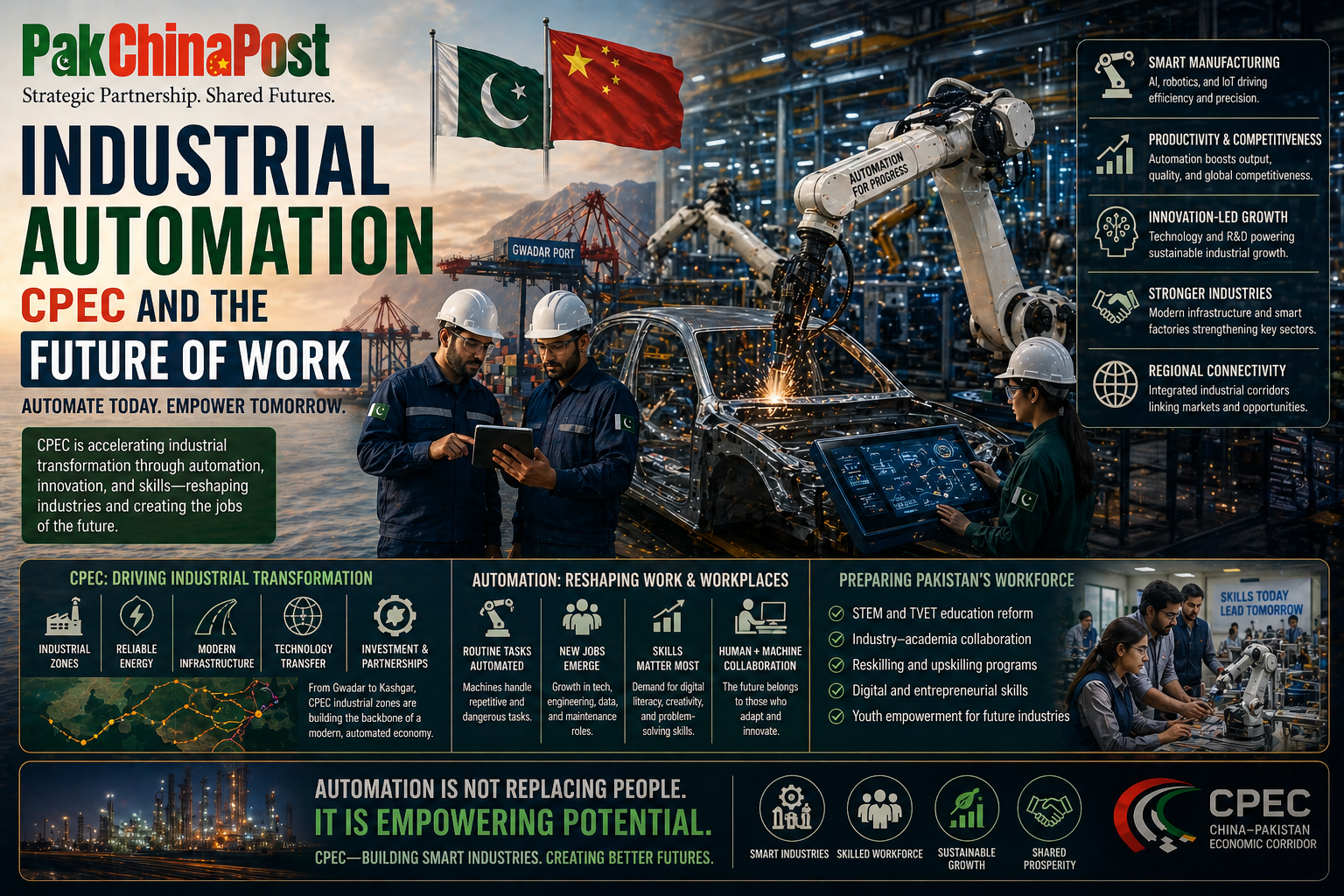
Industrial Automation CPEC and the Future of Work

Industrial automation under CPEC 2.0 is quietly redefining the economic imagination of Pakistan. What was once framed as a corridor of roads, railways, and energy plants is increasingly being reoriented toward a more complex ambition, the restructuring of industrial production itself through robotics,
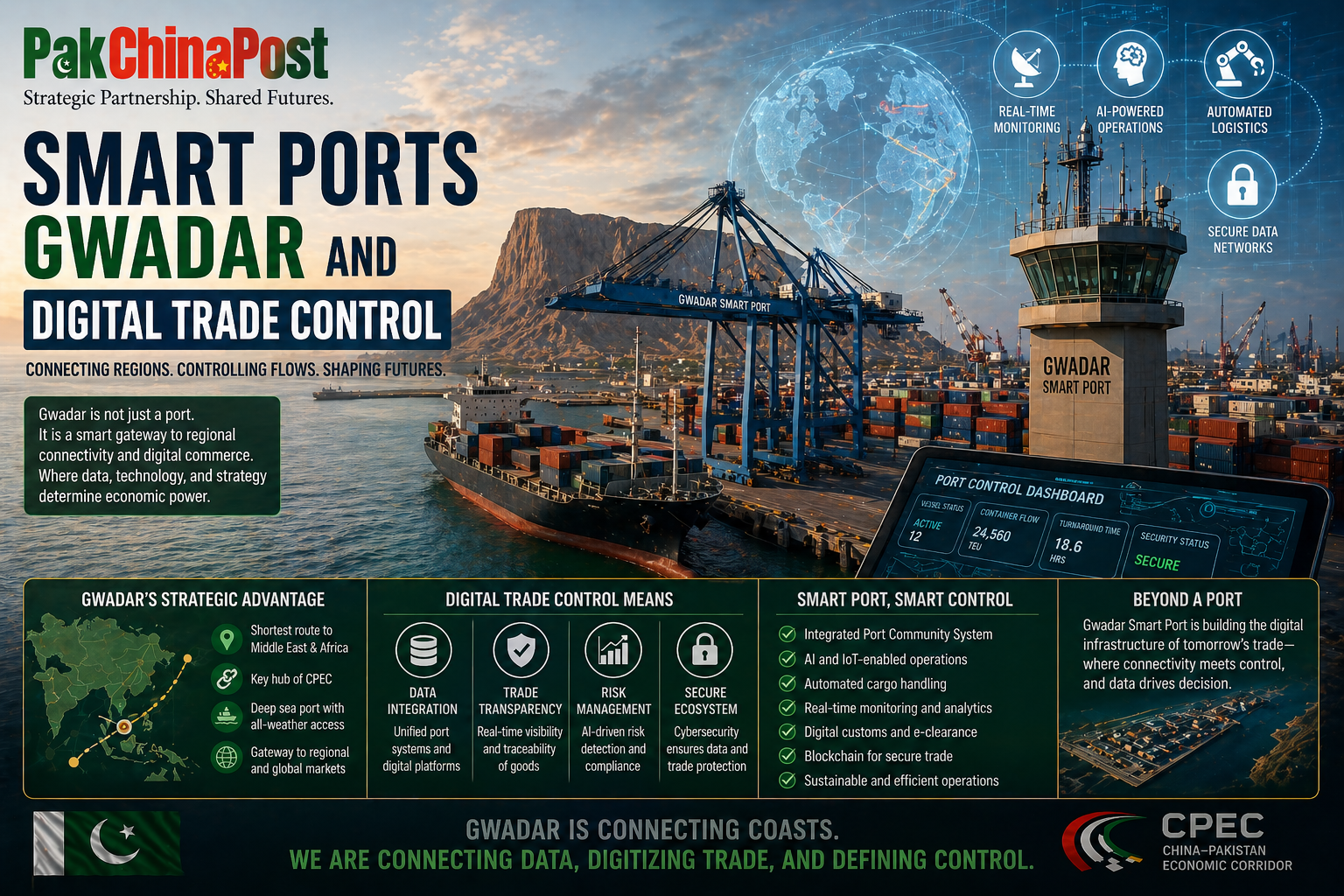
Smart Ports Gwadar and Digital Trade Control

Gwadar is often described in grand strategic language as a future hub of regional connectivity, a maritime gateway linking Central Asia, the Middle East, and Western China through the China Pakistan Economic Corridor. Yet beneath the familiar rhetoric of deep sea ports and
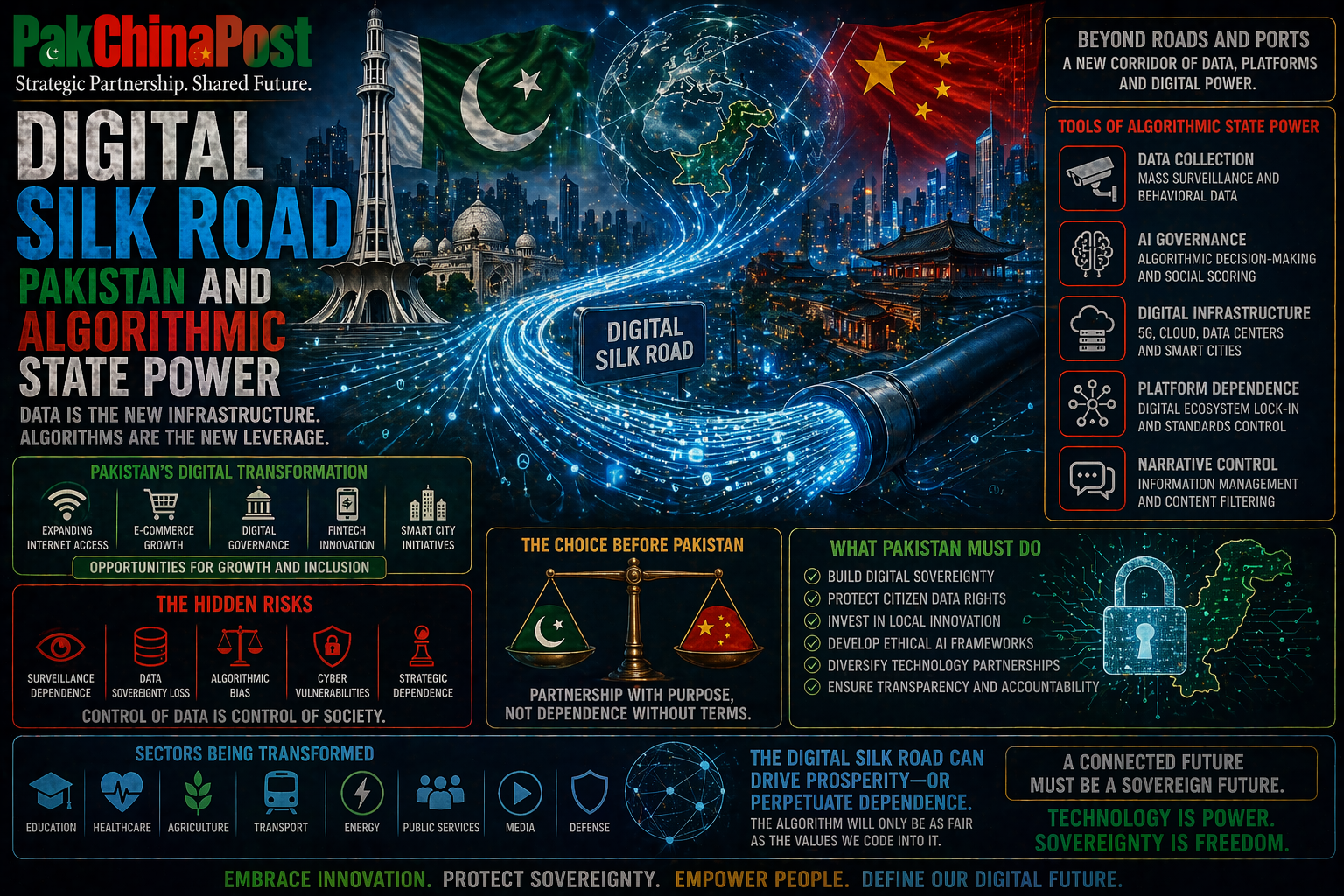
Digital Silk Road Pakistan and Algorithmic State Power
Pakistan’s gradual insertion into China’s Digital Silk Road is no longer a speculative projection of future connectivity. It is an unfolding institutional reality reshaping how the state sees, measures, and governs society. What began as infrastructure cooperation under the China Pakistan Economic Corridor

Sino Pakistan Hybrid Statecraft and the Convergence of Security Economic and Digital Power Systems
The emerging strategic model between China and Pakistan reflects a gradual but profound transformation in the nature of state power, where traditional distinctions between military capability, economic infrastructure, and digital information systems are increasingly dissolving into an integrated framework of hybrid statecraft. This

Intelligence Fusion as the Operational Core of Maritime Power in the Strait of Hormuz
The contemporary contest over maritime influence is no longer adjudicated primarily through platform superiority or visible force posturing; it is increasingly determined within the cognitive and informational layers that precede kinetic engagement. Within this recalibrated battlespace, the Sino–Pak alignment reflects a transition toward

Seeding Innovation Beyond Borders: China’s 5G and 6G Vision in Pakistan’s Technological Ecosystem

In the twenty-first century, the global race for technological leadership is no longer contained within laboratories or boardrooms. It unfolds across borders, in classrooms, innovation parks, and industrial corridors where ideas, talent, and investment converge. China has emerged as a central actor in

China’s Digital Silk Road: Shaping 5G and 6G Connectivity from Beijing to Islamabad
In the unfolding architecture of the twenty-first century’s geopolitical landscape, the frontier of global influence is no longer defined solely by highways, ports, and pipelines. It is increasingly shaped by signals carried on invisible waves, by cables running beneath deserts and mountains, and

Countering Hybrid Warfare through Pakistan-China Intelligence Cooperation
Countering hybrid threats has become one of the most pressing imperatives for states navigating the complex landscape of twenty-first-century geopolitics. In recent years, Pakistan and China have recognized that security challenges have evolved far beyond traditional military confrontations. The emergence of cyberattacks, sophisticated

Technological Convergence and the Reconstitution of Power in the Digital Age
In the unfolding architecture of the twenty first century, power is no longer measured solely by territorial control, military arsenals, or even economic volume in its traditional sense; rather, it is increasingly constituted through technological capability, data ownership, algorithmic intelligence, and the capacity

Between Innovation and Anxiety: Artificial Intelligence and the Future of Human Civilization.
In the long arc of human history, few developments have inspired as much simultaneous awe and unease as Artificial Intelligence. Humanity has always faced existential threats such as climate change, nuclear proliferation, pandemics, and the depletion of natural resources. However, AI represents a