
Youth Development and the China Opportunity in Pakistan

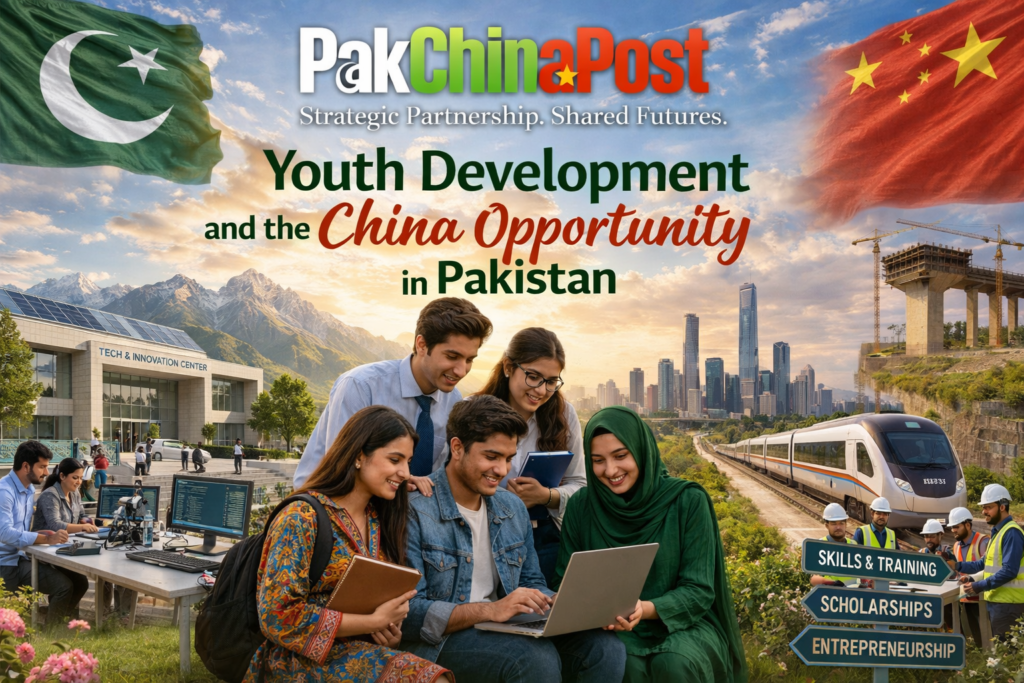
Young people represent the most dynamic and promising segment of Pakistan’s population. Comprising a significant majority of the nation’s demographic profile, they embody the potential for innovation, economic growth, social transformation, and technological advancement. Harnessing this vast reservoir of human capital requires strategic policy frameworks, targeted skill development initiatives, and opportunities for meaningful engagement in high‑impact sectors. In this context, Pakistan’s expanding collaboration with China presents a transformative opportunity for youth development across technology, education, entrepreneurship, and participation in global value chains. China’s evolution from a developing economy to a global leader in technology and industrial modernization offers a valuable model for Pakistan’s youth to emulate and engage with directly. Through educational partnerships, technology exchange programs, entrepreneurship incubators, and cross‑border professional opportunities, young Pakistanis are increasingly positioned to benefit from a deepening bilateral relationship that not only expands their individual potential but also strengthens Pakistan’s socio‑economic landscape.
Pakistan’s youth face multiple structural challenges in attaining meaningful economic participation. Unemployment, underemployment, skill mismatches with labor market needs, and limited access to internationally competitive education have historically constrained youth mobility and socio‑economic upward trajectory. Traditional educational curricula have struggled to keep pace with rapid technological advancements, leaving a gap between theoretical knowledge and practical competencies sought by employers in sectors such as information technology, engineering, advanced manufacturing, and innovation‑driven enterprises. Meanwhile, entrepreneurship ecosystems remain nascent, with limited access to venture capital, incubation infrastructures, and mentorship networks. Within this milieu, China’s engagement offers a spectrum of opportunities that bridge these gaps by fostering skill acquisition, experiential learning, market exposure, and entrepreneurship support that are aligned with global economic trends.
One of the most significant avenues for youth engagement lies in educational collaboration between Pakistani and Chinese institutions. Over the past decade, an increasing number of scholarship programs, exchange initiatives, and joint research platforms have been established to provide Pakistani students with access to China’s world‑class universities and research environments. These educational pathways extend beyond conventional academic degrees to include specialized training in emerging technologies such as artificial intelligence, data science, renewable energy engineering, and digital economy studies. Exposure to China’s rapidly evolving innovation ecosystem equips Pakistani students with not only technical skills but also cross‑cultural competencies and strategic perspectives on industry transformation. These graduates often return to Pakistan with an advanced skill set, a deep understanding of global industry standards, and a network of professional contacts that enhances their employability and entrepreneurial potential.
The technology sector, in particular, has emerged as a key domain where Pakistani youth can leverage opportunities enabled by China‑Pakistan cooperation. China’s own experience in building world‑class technology hubs, digital platforms, and innovation clusters provides a blueprint for Pakistan to cultivate similar ecosystems. Chinese tech companies, in collaboration with Pakistani partners, have participated in initiatives to develop digital infrastructure, support local startups, and establish research and development centers that focus on technological innovation. These partnerships often include internship and apprenticeship programs that enable young Pakistanis to acquire hands‑on experience in software development, product design, systems engineering, and digital marketing. Such immersion in real‑world tech environments accelerates skill acquisition and builds confidence among young professionals navigating competitive global markets. Furthermore, exposure to China’s entrepreneurial culture—characterized by rapid prototyping, agile product development, and scalable business models—stimulates new ways of thinking among Pakistani youth who aspire to establish their own ventures.
Innovation hubs and startup incubators are another critical dimension of youth engagement under the China framework. Recognizing that entrepreneurship plays a vital role in job creation and economic diversification, numerous initiatives have been launched to support Pakistani youth in transforming ideas into commercially viable enterprises. These hubs provide essential services such as mentorship, seed funding, market research support, legal consultation, and access to investor networks. When integrated with Chinese expertise and capital, these platforms create an environment conducive to innovation and economic experimentation. Chinese partners often contribute strategic guidance on business modeling, intellectual property management, and global market entry strategies—knowledge that is invaluable for young entrepreneurs seeking to scale their ventures beyond domestic boundaries. In addition, joint innovation challenges, hackathons, and startup competitions sponsored by Chinese institutions provide youth with platforms to showcase their ideas, receive constructive feedback, and attract potential investment. Such engagements foster a culture of creativity, resilience, and global outlook among emerging Pakistani entrepreneurs.
Participation in global value chains constitutes another significant opportunity for Pakistan’s youth. China’s role as a central hub in global manufacturing and trade networks provides pathways for young Pakistanis to engage in value‑added production, quality control, logistics coordination, and international commerce. Through joint ventures, industrial partnerships, and connectivity initiatives under frameworks such as the China‑Pakistan Economic Corridor, young professionals gain exposure to international standards, supply chain optimization techniques, and production excellence benchmarks. These experiences not only enhance their technical and managerial skills but also position them to compete in global labor markets and contribute to domestic industrial growth. Integration into global value chains also stimulates demand for specialized skills in areas such as quality assurance, export compliance, industrial automation, and supply chain analytics—fields where young Pakistanis can build sustainable careers.
Skill development programs have emerged as a cornerstone of youth empowerment in the context of China‑Pakistan engagement. Recognizing the critical importance of aligning education with market demand, both governments and private sector partners have supported vocational and technical training programs tailored to emerging industries. These programs encompass a broad range of competencies, from advanced manufacturing techniques and renewable energy systems to data analytics and cybersecurity. By equipping young learners with skills that are relevant to high‑growth sectors, these initiatives reduce structural unemployment while enhancing national competitiveness. Chinese training modules often include practical components such as laboratory sessions, field projects, and industry internships that bridge classroom knowledge with experiential learning. These immersive approaches not only improve technical proficiency but also cultivate problem‑solving abilities, teamwork, and professional adaptability—traits that are highly valued in dynamic economic sectors.
In addition to institutional training, mentorship and professional networking opportunities play a critical role in youth development. Chinese business leaders, academics, and industry experts frequently participate in workshops, seminars, and joint forums that bring together young Pakistani professionals and their Chinese counterparts. Such engagements facilitate dialogue, knowledge exchange, and relationship building that extend beyond transactional interactions. For emerging professionals, access to mentorship from experienced practitioners accelerates career growth by providing insights into strategic decision‑making, industry trends, and leadership development. These mentorship networks often serve as conduits for cross‑border collaboration, joint research, and co‑creation of projects that further integrate youth into the bilateral economic fabric.
Entrepreneurship financing has also seen innovative models emerge through China‑Pakistan cooperation. Recognizing that access to capital is a major constraint for young entrepreneurs, financial mechanisms such as seed funds, angel investment networks, and venture capital partnerships with Chinese investors have been established to support early‑stage startups. These financing channels not only provide critical capital but also introduce young entrepreneurs to investor expectations, governance standards, and strategic growth planning. Chinese investors, with their experience in scaling businesses and navigating international markets, contribute not only funds but strategic guidance that enhances the likelihood of entrepreneurial success. Access to diversified financing reduces the barriers to innovation and encourages young Pakistanis to pursue business ventures that address local needs while aspiring for global relevance.
The cultural dimension of youth engagement should not be underestimated. Beyond economic and technical collaboration, exchange programs that expose Pakistani youth to Chinese language, culture, and societal norms enhance mutual understanding and cross‑cultural competencies—skills that are increasingly valuable in a globalized world. Learning Mandarin, participating in cultural immersion programs, and engaging with communities in China broaden perspectives and foster greater appreciation of diverse worldviews. Such experiences enrich Pakistan’s youth intellectually and socially, enabling them to serve as cultural ambassadors who contribute to deeper bilateral ties at the people‑to‑people level. These cultural competencies complement professional skills, making young Pakistanis more adaptable, globally aware, and equipped to navigate international environments.
Women’s participation in youth development initiatives represents another dimension of inclusive growth supported through China‑Pakistan collaboration. Gender equity in education, technology fields, and entrepreneurship remains a development priority in Pakistan. Initiatives that specifically target young women for STEM education, leadership training, and startup support enable broader socio‑economic inclusion. Chinese partners have participated in workshops, scholarship programs, and mentorship initiatives that encourage female participation in emerging sectors, thereby expanding the talent pool and reinforcing the principle that youth development should be inclusive. Empowering young women through targeted engagement amplifies economic productivity, fosters diverse perspectives in innovation ecosystems, and supports more equitable development outcomes.
Research collaboration between Pakistani and Chinese universities further enhances youth engagement in high‑impact sectors. Joint research projects, co‑authored publications, and collaborative laboratories enable students and early career researchers to engage with global challenges such as climate‑smart agriculture, renewable energy systems, urban digital governance, and public health analytics. These collaborative research environments are incubators of ideas that can be translated into policy insights, startup ventures, and technological innovations that contribute both to national development and global knowledge networks. Chinese research institutions bring strengths in applied sciences, engineering, and innovation ecosystems that complement Pakistan’s academic aspirations, creating synergistic environments where research excellence can flourish.
The role of digital platforms in expanding opportunities for Pakistan’s youth cannot be overlooked. E‑learning initiatives, virtual exchange programs, and online mentorship platforms have enabled wider access to Chinese educational resources, professional networks, and entrepreneurial communities. Through digital connectivity, young Pakistanis can participate in webinars, certification programs, and virtual internship experiences that would otherwise be inaccessible due to geographical constraints. These digital avenues democratize access to knowledge and professional growth opportunities, ensuring that youth in remote or underserved areas are not excluded from progress. By leveraging digital infrastructure, both nations enhance the inclusivity and reach of youth development initiatives.
Pakistan’s participation in technology and innovation exhibitions in China further exposes young professionals to cutting‑edge advancements and global industry trends. These events provide platforms for Pakistani students, researchers, and entrepreneurs to showcase their innovations, engage with international experts, and benchmark their ideas against global standards. Such exposure stimulates ambition, enhances technical insight, and inspires youth to seek collaborative opportunities that transcend national boundaries. Participation in these forums reinforces the notion that Pakistani talent has a place in international innovation ecosystems, further motivating youth to pursue excellence.
Policy frameworks that support youth engagement are critical to sustaining momentum. The Governments of Pakistan and China have periodically reviewed and updated policies that facilitate educational exchange, professional mobility, entrepreneurial collaboration, and joint research. These policy initiatives ensure that institutional barriers are minimized, funding mechanisms are accessible, and bilateral initiatives remain aligned with broader socio‑economic goals. By creating a supportive policy environment, both nations demonstrate a long‑term commitment to empowering youth as active contributors to national development and global integration.
In conclusion, youth development in Pakistan stands at the intersection of demographic promise and structural challenges. The China opportunity—which spans education, technology, entrepreneurship, global value chain integration, skill development, mentorship, financing, cultural exchange, research collaboration, and inclusive policy frameworks—provides a comprehensive platform for young Pakistanis to realize their full potential. This engagement not only benefits individual career trajectories but also contributes to Pakistan’s broader socio‑economic transformation. By embracing collaborative frameworks that incorporate international standards, practical experience, and innovation‑driven growth, Pakistan’s youth are increasingly equipped to contribute meaningfully to national development and global competitiveness. China’s role as a proactive partner in these endeavors reflects a shared vision of empowering young people as architects of a prosperous, interconnected future. This sustained commitment to youth development through strategic cooperation exemplifies how bilateral engagement can transform demographic potential into socioeconomic dynamism and long‑term resilience.
A Public Service Message