
Energy Shock to Energy Security Pakistan


Pakistan’s energy question has long been framed as a problem of shortage, but that framing is increasingly outdated. The country no longer suffers from a simple lack of generation capacity. Instead, it faces a deeper structural contradiction between imported energy dependence, inefficient domestic systems, and a volatile global fossil fuel market that repeatedly transmits external shocks into domestic inflation, fiscal stress, and industrial competitiveness. In this context, the emerging cooperation with China in renewable energy, storage systems, and grid modernisation is not merely a technical upgrade. It is a potential redefinition of what energy security means for Pakistan in the twenty first century.
For decades, Pakistan’s energy architecture has been anchored in hydrocarbons imported primarily from the Gulf region. Crude oil, refined petroleum products, and liquefied natural gas have formed the backbone of transport, industry, and power generation. This dependency created a structural vulnerability that is not episodic but systemic. When global oil prices rise due to geopolitical shocks, supply disruptions, or demand surges, Pakistan experiences immediate transmission into its domestic economy through higher import bills, widening current account deficits, and currency depreciation. Inflation follows, particularly in transport and food prices, and monetary tightening often slows growth.
The electricity sector reflects an even more complex distortion. Installed capacity increased significantly in the past decade, largely through thermal and imported fuel based plants. Yet affordability did not improve proportionally. Capacity payments, fuel cost adjustments, transmission losses, and circular debt accumulation created a system where electricity exists in physical terms but remains economically and institutionally unstable. The result is paradoxical. Pakistan often has enough generation capacity on paper, yet struggles with high tariffs, unreliable supply, and financial stress within distribution companies.
This dual crisis of external fuel dependence and internal inefficiency creates what might be described as energy fragility rather than mere scarcity. It is precisely this fragility that makes the potential role of Chinese renewable technology and grid systems strategically significant. China is not only the world’s largest producer of solar panels and wind turbines. It also leads in battery storage systems, high voltage transmission technologies, and integrated grid management solutions. Its domestic experience in rapidly scaling renewable capacity while maintaining grid stability offers lessons that are directly relevant to Pakistan’s transition challenges.
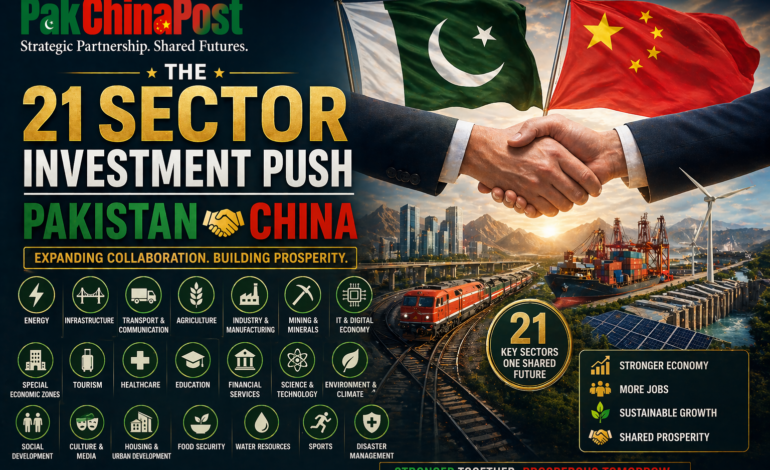
Recent developments under broader China Pakistan cooperation frameworks indicate a shift toward energy diversification beyond conventional generation. Discussions increasingly focus on solar farms, wind corridors in Sindh and Balochistan, hydro expansion, battery energy storage systems, and smart grid integration. Unlike earlier phases of cooperation that emphasised large scale coal or oil based projects, the emerging emphasis is on distributed, flexible, and hybrid systems that can respond to demand fluctuations more efficiently.
Solar energy represents the most immediate opportunity. Pakistan’s geographical position provides high solar irradiance across much of its territory, particularly in southern and western regions. Rooftop solar adoption has already begun informally, driven by rising grid electricity prices and declining panel costs. Chinese manufacturing dominance in photovoltaic modules has made solar technology more accessible globally, and Pakistan is a natural market for scaled deployment. However, without storage and grid integration, solar expansion risks creating a parallel energy system that is productive but not fully integrated into national planning.
This is where battery storage becomes critical. Renewable energy is inherently intermittent. Solar power peaks during daylight hours while demand often spikes in the evening. Without storage capacity, this mismatch reduces system efficiency and increases reliance on thermal backup generation. Chinese advancements in lithium ion battery production and large scale storage deployment offer Pakistan an opportunity to stabilise renewable integration. If storage systems are deployed at utility scale, solar generation can move from supplementary to foundational status.
Wind energy complements this transition. Pakistan’s coastal belt and certain inland corridors possess significant wind potential. Yet wind projects have historically faced grid connectivity challenges and transmission constraints. Chinese expertise in long distance transmission and grid balancing can help unlock this resource more effectively. However, wind and solar together still require a systemic rethink of grid architecture rather than piecemeal additions.
The grid itself is perhaps the most underestimated component of energy security. Generation without transmission efficiency is economically wasted capacity. Pakistan’s grid suffers from outdated infrastructure, high transmission losses, weak digital monitoring, and limited predictive management. Smart grid technologies, including automated load balancing, real time consumption tracking, and predictive maintenance systems, could significantly reduce inefficiencies. Chinese firms have extensive experience deploying such systems at scale, particularly in rapidly urbanising regions.
Yet technology transfer alone does not guarantee transformation. Institutional capacity remains a binding constraint. Energy governance in Pakistan is fragmented across federal ministries, provincial authorities, distribution companies, and regulatory bodies. Coordination failures lead to delayed projects, inconsistent tariff structures, and weak accountability mechanisms. Even the most advanced technologies cannot compensate for structural governance deficits.
Energy security is therefore not simply a matter of substituting imported oil with renewable generation. It is about restructuring the entire value chain of energy production, distribution, pricing, and consumption. Without tariff reform, circular debt resolution, and institutional consolidation, renewable energy may reduce environmental stress but fail to resolve fiscal instability.
There is also a macroeconomic dimension that is often overlooked. Energy imports are one of the largest components of Pakistan’s external expenditure. Any reduction in fossil fuel dependence directly improves the current account balance. However, renewable energy infrastructure itself requires imported capital equipment, much of it from China. In the short term, this may not eliminate import dependence but shift its composition from recurrent fuel imports to capital imports. The long term benefit emerges only if domestic manufacturing, maintenance, and service ecosystems develop around renewable technologies.
This raises an important question. Can Pakistan move from being a consumer of Chinese energy equipment to a partial producer or assembler of such systems? Industrial policy integration between energy and manufacturing sectors will determine whether energy transition also becomes an industrialisation opportunity. For instance, local assembly of solar panels, battery components, and grid equipment could generate employment while reducing foreign exchange pressure.
The geopolitical dimension of energy cooperation also deserves attention. Energy systems are no longer purely economic infrastructures. They are strategic assets embedded in broader regional alignments. China’s involvement in Pakistan’s energy transition strengthens its role as a long term infrastructural partner in South Asia. For Pakistan, this deepens dependence but also provides access to technology that might otherwise be unaffordable or unavailable through Western markets due to financing constraints or policy restrictions.
However, over reliance on a single technological partner carries risks. Diversification of suppliers, even within a China anchored system, remains important for resilience. Moreover, energy sovereignty is not achieved merely through shifting suppliers. It is achieved through building domestic capacity to manage, adapt, and eventually innovate within imported systems.
Climate change adds another layer of urgency. Pakistan is among the countries most vulnerable to climate induced disruptions, including heatwaves, floods, and glacial melt. These events directly affect energy demand patterns and infrastructure stability. Renewable energy transition is therefore not only an economic necessity but also an adaptation strategy. Distributed solar systems, for example, can provide decentralised resilience during grid disruptions caused by extreme weather events.
Yet transition pathways are rarely linear. Fossil fuels will remain part of Pakistan’s energy mix for the foreseeable future, particularly in transport and heavy industry. The objective is not immediate elimination but gradual rebalancing. The pace of this rebalancing will determine whether Pakistan experiences managed transition or continued volatility.
Energy pricing reform remains perhaps the most politically sensitive aspect of this transformation. Subsidised tariffs, delayed adjustments, and cross subsidisation have historically distorted consumption patterns and discouraged efficiency. Any transition toward renewable integration must also confront the reality that energy pricing must reflect economic cost if the system is to remain viable.
In this context, Chinese cooperation can provide technical tools but cannot resolve political economy constraints. Smart meters, grid upgrades, and renewable plants can improve supply conditions, but they cannot alone resolve distribution company inefficiencies or political resistance to tariff rationalisation.
The broader question, therefore, is whether Pakistan can convert energy shock into energy security. Shock refers to vulnerability, exposure, and external dependency. Security refers to stability, predictability, and domestic control over energy systems. The transition from one to the other is not automatic. It requires coordinated reform across technology, governance, pricing, and industrial policy.
China’s role in this process is significant but not deterministic. It provides hardware, finance, and technical expertise. Pakistan must provide institutional reform, policy continuity, and implementation discipline. Without this alignment, renewable projects risk becoming parallel additions to a fundamentally unchanged system.
If alignment is achieved, however, Pakistan could gradually move toward a hybrid energy model where imported fossil fuel volatility is reduced, renewable penetration increases, and grid stability improves. In such a scenario, energy would shift from being a recurring macroeconomic crisis driver to a stabilising factor in economic planning.
The stakes are therefore not limited to kilowatts or megawatts. They extend to fiscal stability, industrial competitiveness, climate resilience, and geopolitical positioning. Energy transition is not a sectoral adjustment. It is a structural reorganisation of Pakistan’s economic foundation.
A Public Service Message