The 21 Sector Investment Push Pakistan China

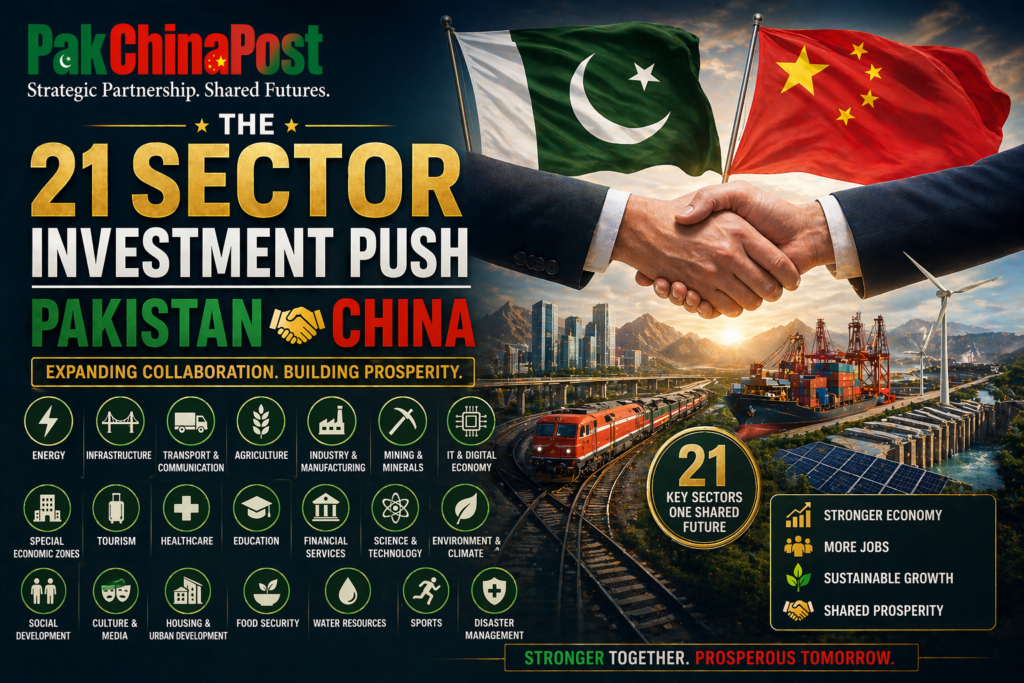
Pakistan’s recent attempt to reorganise its investment diplomacy around twenty one priority sectors marks a quiet but important shift in how the country presents itself to foreign capital, particularly Chinese investors. For much of the past two decades, Pakistan’s investment narrative has oscillated between broad appeals for foreign direct investment and episodic sector specific incentives that rarely survived political cycles. The new framework, which clusters engagement into defined industrial and service categories, suggests an emerging recognition that modern investment flows are no longer driven by generic invitations but by structured ecosystems, predictable policies, and sectoral depth.
At first glance, the idea of identifying twenty one sectors may appear bureaucratic, even arbitrary. Yet it reflects an attempt to move away from fragmented economic planning toward what could be described as portfolio based industrial diplomacy. Instead of asking investors to “invest in Pakistan,” the state is now implicitly asking them to enter clearly demarcated domains where infrastructure, incentives, regulatory support, and Chinese partnership can be aligned more systematically. This is closer to how East Asian economies historically managed foreign capital, not as dispersed inflows but as targeted instruments for industrial upgrading.
China is central to this recalibration. Not only because of its role as Pakistan’s largest infrastructure partner under broader corridor cooperation, but because Chinese firms themselves are undergoing structural transformation. Rising wages, tightening environmental regulations, domestic market saturation in low margin industries, and global supply chain reconfiguration have encouraged Chinese manufacturers to internationalise production. This outward movement is not uniform. It is selective, strategic, and increasingly segmented by industry maturity.
Pakistan is attempting to position itself within this selective relocation wave. The twenty one sectors reportedly under focus include information technology, agriculture processing, pharmaceuticals, home appliances, electric equipment, mining, logistics, textiles upgrading, renewable energy, construction materials, healthcare services, and industrial manufacturing segments. The logic is to capture both labour intensive relocation and mid technology assembly operations that are being partially displaced from China’s coastal provinces.
However, attracting investment is not the same as absorbing it productively. The history of foreign direct investment in Pakistan is replete with cycles of enthusiasm followed by underperformance. Projects are announced with fanfare, memoranda are signed, delegations are exchanged, but execution often slows due to regulatory uncertainty, infrastructure bottlenecks, taxation disputes, currency volatility, and security concerns. The gap between announcement and operationalisation remains the country’s most persistent economic weakness.
The current push attempts to address this by moving toward sector clustering. Instead of isolated projects scattered across provinces, the idea is to develop integrated industrial ecosystems. For example, appliance manufacturing would require not only factories but also component suppliers, logistics networks, trained labour, tariff stability, and export facilitation. Similarly, agro processing depends on cold chain infrastructure, storage systems, packaging industries, and export certification regimes. Without these supporting layers, investment remains shallow and import dependent rather than transformative.
One of the most significant potential gains lies in agricultural industrialisation. Pakistan’s economy remains deeply agrarian in structure but weak in value addition. Large portions of produce are lost after harvest due to inadequate storage, transportation inefficiencies, and limited processing capacity. Chinese investment in food processing, irrigation technology, mechanised farming, and supply chain logistics could dramatically reduce these losses. Yet the challenge is not technological availability but institutional coordination between federal, provincial, and private actors.
Manufacturing sectors, particularly light engineering, electrical goods, and textiles upgrading, represent another core area. Pakistan’s textile industry already forms the backbone of its exports, but it remains heavily concentrated in low to mid value segments. Moving toward branded apparel, technical textiles, and diversified export baskets requires not just capital but design capability, compliance systems, and access to high value markets. Chinese firms can provide machinery and scale, but upgrading value chains depends on domestic entrepreneurial adaptation.
The push toward electric equipment and renewable related industries reflects global structural shifts. As the world transitions toward electrification, batteries, and digital energy systems, countries that fail to integrate early risk long term marginalisation. Pakistan’s interest in battery assembly, solar manufacturing, and electrical infrastructure components aligns with this global trend. Yet such industries are capital intensive, technologically complex, and require stable policy environments to attract long term investment.
Information technology and digital services are often highlighted as Pakistan’s comparative advantage due to its young population and growing freelance economy. However, scaling from dispersed service exports to structured digital industries requires investment in education, infrastructure, data governance, and regulatory clarity. Chinese tech companies, already operating in multiple emerging markets, could provide platforms for scaling, but issues of digital sovereignty and regulatory alignment will inevitably arise.
Mining represents a different category altogether. Pakistan’s resource base, including copper, gold, coal, and rare earth potential, offers significant long term economic opportunity. Chinese firms already have experience in large scale mining operations across Africa, Latin America, and Central Asia. However, resource extraction without domestic value addition risks repeating the classical pattern of enclave economies. The strategic question is whether Pakistan can move from raw extraction to processing and refining, thereby capturing more value within its borders.
Logistics and infrastructure remain the connective tissue of all twenty one sectors. Without efficient ports, rail connectivity, warehousing, customs systems, and digital tracking mechanisms, sectoral investment cannot scale. China’s experience in building integrated logistics ecosystems is highly relevant here. Yet logistics efficiency depends not only on physical infrastructure but also on institutional speed. Clearance delays, bureaucratic friction, and inconsistent enforcement often negate infrastructure gains.
Healthcare and pharmaceuticals offer another emerging frontier. Pakistan imports a significant portion of its pharmaceutical inputs and relies heavily on external supply chains for medical equipment. Joint ventures with Chinese firms in generic drug manufacturing, medical device production, and hospital infrastructure could reduce import dependence while improving domestic healthcare access. However, regulatory harmonisation and quality control mechanisms will be critical.
Construction materials and housing related industries are also included in the investment framework. Pakistan faces a chronic housing deficit alongside rapid urbanisation. Cement, steel, prefabricated construction systems, and affordable housing technologies represent potential growth areas. Chinese construction firms, already experienced in large scale urban development projects, could contribute to this segment, but affordability and financing models will determine accessibility.
The underlying logic of the twenty one sector approach is therefore not merely diversification, but industrial mapping. It attempts to identify where Pakistan can realistically integrate into global value chains through Chinese partnership. Yet mapping alone does not create movement. Execution requires what economists often describe as institutional coherence, the alignment of policy, regulation, infrastructure, and human capital toward a shared industrial objective.
There is also a deeper geopolitical dimension. Sector based investment diplomacy allows Pakistan to position itself not as a passive recipient of aid or loans, but as a negotiated partner in global production networks. This matters in a world where economic influence is increasingly exercised through supply chains rather than traditional aid flows. China’s own economic model has evolved from capital exporter to ecosystem builder. Pakistan’s strategy reflects an attempt to embed itself within that ecosystem.
However, dependency risks remain. If investment flows are overwhelmingly tied to a single external partner, technological and financial dependence may deepen even as industrial capacity expands. True diversification would require attracting additional partners from the Gulf, Europe, and East Asia beyond China, thereby balancing exposure and increasing bargaining space.
Another critical challenge is absorptive capacity. Pakistan’s education system, vocational training institutions, and industrial skill base remain insufficient for rapid industrial scaling. Without parallel investment in human capital, even well-structured sectoral inflows may result in assembly level operations rather than deep manufacturing capability. This would limit long term productivity gains.
Fiscal incentives also require careful calibration. Excessive tax holidays or tariff exemptions may attract investment in the short term but erode fiscal space and create distortions. The experience of many developing economies suggests that incentives alone do not guarantee sustainable industrialisation. Predictability, infrastructure quality, and governance efficiency often matter more.
Ultimately, the twenty-one sector investment push represents a shift in ambition rather than a guarantee of outcome. It signals that Pakistan is attempting to move from opportunistic investment attraction to structured industrial planning. Whether this transition succeeds depends on whether the state can maintain policy continuity beyond political cycles, enforce regulatory discipline, and build credible institutions that outlast individual governments.
If successful, the framework could become a foundation for gradual integration into regional and global production networks, particularly through Chinese industrial expansion. If unsuccessful, it risks becoming another entry in a long history of well-articulated but poorly implemented economic strategies.
The difference will not be made by announcements or conferences, but by whether factories are built, exports rise, skills improve, and productivity increases. In the end, investment diplomacy is judged not by how many sectors are listed, but by how many sectors produce.