
Rethinking Development Finance In A Fragmented Global Order

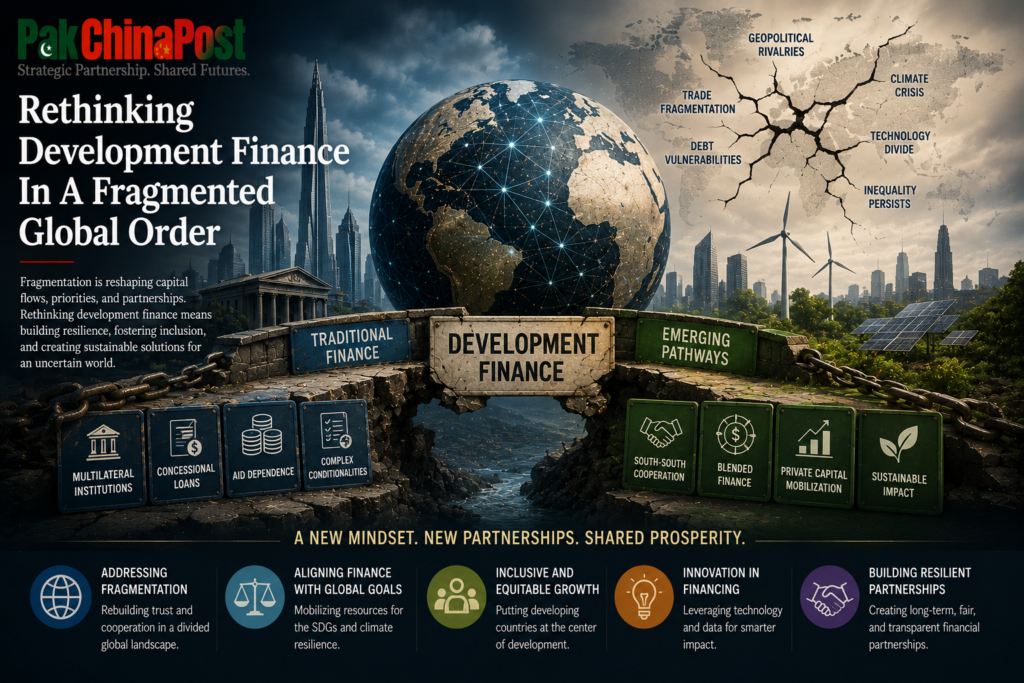
The architecture of global development finance is undergoing a quiet but profound crisis of legitimacy. Institutions once designed to stabilise post war reconstruction and later to manage orderly globalisation now operate in an environment defined by fragmentation, geopolitical rivalry, debt saturation, and climate induced volatility. The World Bank and the International Monetary Fund, long regarded as the twin pillars of economic governance, find themselves increasingly misaligned with the structural realities of the twenty first century. Their instruments, originally calibrated for cyclical shocks and linear growth trajectories, are now being applied to a world shaped by compounding crises that are neither cyclical nor linear, but systemic and recursive.
At the heart of this tension lies a fundamental mismatch between institutional design and contemporary economic ontology. The Bretton Woods framework was constructed on the assumption that global instability would be episodic and manageable through coordinated liquidity provision, conditional lending, and structural adjustment. Yet the present global economy is characterised by overlapping disruptions: sovereign debt distress in the Global South, deindustrialisation pressures in parts of the developed world, geopolitical decoupling between major economic blocs, and climate related shocks that increasingly function as macroeconomic variables rather than exogenous events.
In such a context, the traditional toolkit of development finance appears increasingly constrained. Conditionality based lending, once justified as a mechanism to enforce fiscal discipline and structural reform, now often produces procyclical tightening in economies already experiencing contractionary pressures. Debt restructuring frameworks remain slow, fragmented, and politically encumbered, frequently delivering relief too late to prevent long term developmental scarring. Meanwhile, concessional financing remains insufficient relative to the scale of climate adaptation needs and infrastructure deficits across low income economies.
The fragmentation of the global economic order has further complicated the operational neutrality of these institutions. Competing geopolitical spheres of influence have introduced alternative financing channels, including bilateral lending, regional development banks, and strategic infrastructure initiatives. While these alternatives have expanded available liquidity, they have also diluted the coherence of global financial governance, producing a system in which standards, conditionalities, and strategic objectives diverge across lending regimes. The result is not a replacement of Bretton Woods institutions but a gradual erosion of their centrality.
This diffusion of authority raises critical questions about the future relevance of established development frameworks. If global capital flows are increasingly shaped by geopolitical alignment rather than uniform risk assessment, then the assumption of technocratic neutrality embedded in traditional multilateral lending becomes difficult to sustain. Development finance is no longer merely an economic instrument; it is increasingly an extension of strategic statecraft.
One of the most visible manifestations of this shift is the growing inadequacy of sovereign debt architecture. A rising number of low and middle income countries are now caught in what can be described as a liquidity solvency continuum, where short term liquidity shortages mask deeper structural insolvency risks. Existing restructuring mechanisms are fragmented across creditor classes, including Paris Club members, private bondholders, and non traditional bilateral lenders, each operating under different incentive structures and legal frameworks. This fragmentation has created a coordination problem that significantly delays resolution processes and prolongs economic distress.
In parallel, climate finance has exposed another dimension of institutional inadequacy. While commitments to climate related funding have expanded rhetorically, actual disbursement levels remain far below estimated adaptation and mitigation requirements. Developing economies, particularly those with limited fiscal space, face the paradox of being both highly vulnerable to climate shocks and structurally constrained in their capacity to finance resilience. The absence of integrated climate debt instruments further exacerbates this vulnerability, as environmental shocks increasingly translate into fiscal crises.
Against this backdrop, the question is not merely whether existing institutions require reform, but whether their foundational assumptions remain valid. The prevailing development finance paradigm is anchored in the notion of convergence, the idea that economies move along a predictable path toward higher productivity and institutional maturity. Yet contemporary evidence suggests a more fragmented trajectory, where divergence, stagnation, and partial integration coexist within the same global system.
This raises difficult questions for policymakers and institutional designers alike. Should development finance continue to prioritise conditional structural adjustment, or should it pivot toward counter cyclical resilience building? Should debt sustainability frameworks be recalibrated to account for climate vulnerability and geopolitical exposure? Should multilateral institutions evolve from lenders of last resort into systemic stabilisers with broader mandates that include global public goods provision?
Emerging proposals suggest incremental movement in this direction, including debt pause clauses linked to climate shocks, expanded use of special drawing rights, and hybrid financing instruments that blend concessional capital with private sector participation. However, these reforms remain partial and often constrained by political disagreement among major shareholders. The result is a reform process that is adaptive at the margins but structurally conservative at the core.
There is also a deeper epistemological issue at stake. Development finance has historically been guided by a belief in technical rationality, the assumption that economic instability can be resolved through optimal policy design and correct sequencing of reforms. Yet in a fragmented global order, instability is increasingly endogenous to the system itself. Financial volatility, geopolitical competition, and ecological disruption are not external shocks but embedded features of the global economy.
This shift requires a rethinking of what development finance is fundamentally meant to achieve. If the objective is no longer simply convergence toward a uniform model of development, but rather the management of persistent instability across heterogeneous economic systems, then institutional mandates must evolve accordingly. This may involve a shift from project based lending toward systemic resilience financing, from conditionality enforcement toward adaptive governance frameworks, and from reactive crisis response toward anticipatory risk mitigation.
For developing economies, the implications are profound. Access to finance is no longer solely a question of capital availability but of structural positioning within a fragmented global order. Countries situated at the intersection of geopolitical competition often experience both opportunities and constraints, as alternative financing sources increase bargaining space while simultaneously introducing new dependencies. In such an environment, economic sovereignty becomes increasingly relational rather than absolute.
At the policy level, this necessitates a more strategic approach to engagement with multilateral institutions. Rather than treating development finance as a purely external input, states must increasingly integrate it into long term national planning frameworks that account for volatility, fragmentation, and multi source financing landscapes. This includes strengthening domestic revenue systems, enhancing debt transparency, and building institutional capacity to manage complex financing portfolios.
Ultimately, the future of development finance will be shaped not by the preservation of existing institutional forms, but by their capacity to adapt to a world in which stability is no longer the default condition. The challenge is not simply to repair the Bretton Woods system, but to reimagine its function in an era where fragmentation is not an anomaly but a defining structural feature of global capitalism.
In this evolving landscape, the success of multilateral institutions will depend less on their ability to enforce uniform policy prescriptions and more on their capacity to accommodate heterogeneity, absorb shocks, and facilitate coordination in an increasingly disordered system. Whether they can make this transition remains an open question, but the cost of failure will not be measured in institutional decline alone, but in the deepening instability of the global economy they were originally created to stabilise.
A Public Service Message