

Informal Economy Eroding Pakistan Fiscal Sovereignty Quietly

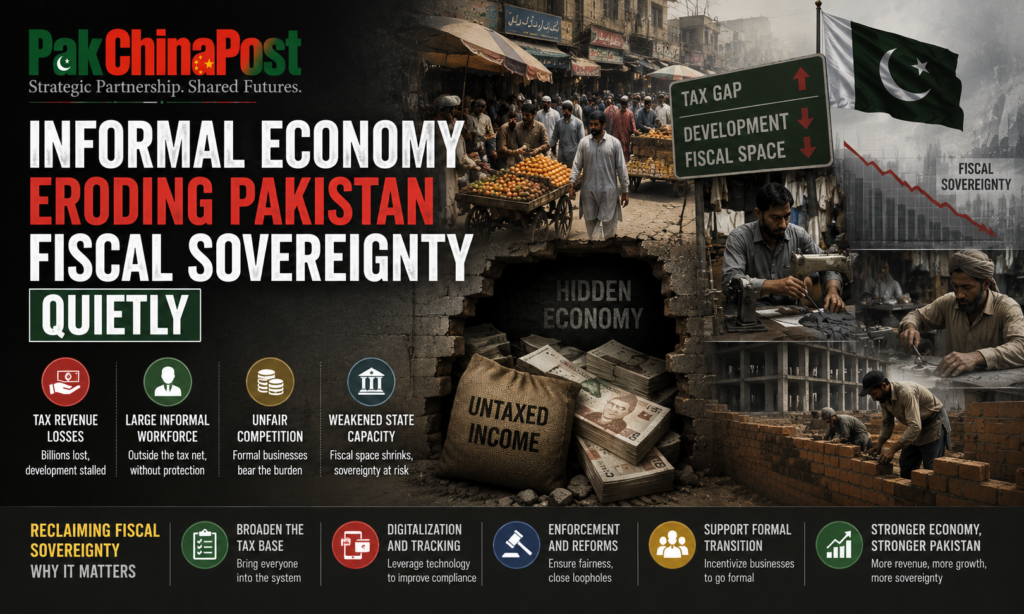
Pakistan’s expanding informal economy has evolved into one of the most structurally consequential yet politically underexamined forces shaping the country’s fiscal sovereignty, institutional authority, and long term governance capacity. What is often described in policy discourse as “informality” is a deeply embedded parallel economic system that now interacts continuously with formal markets, state institutions, and political power structures, gradually redefining the boundaries of taxation, regulation, and economic legitimacy. The result is not merely revenue leakage, but a systemic weakening of the state’s ability to govern economic life through formal mechanisms.
At the heart of this transformation lies a persistent dual economy structure. On one side exists a formal sector constrained by taxation compliance, regulatory oversight, and documented transactions. On the other side operates an expansive informal ecosystem characterized by cash-based trade, under invoicing, undocumented labour arrangements, and shadow financial flows that bypass official statistical capture. Over time, this parallel system has ceased to be marginal and has instead become structurally dominant in several sectors, including retail trade, construction, transport, real estate, and segments of agriculture and services.
The fiscal implications are severe. Pakistan’s tax to GDP ratio remains persistently low compared to peer economies, not solely due to administrative inefficiency but because large segments of economic activity remain outside the taxable net. This creates a narrowing fiscal base that forces the state to rely disproportionately on indirect taxation, import duties, and withholding mechanisms that place a heavier burden on documented economic actors. The result is a regressive tax structure that deepens inequality while simultaneously constraining investment incentives within the formal economy.
Elite capture plays a central role in sustaining this equilibrium. Influential economic actors often benefit from regulatory exemptions, under reporting mechanisms, and political patronage networks that allow for strategic navigation between formal compliance and informal operational flexibility. This creates a segmented compliance culture in which taxation is not uniformly enforced but selectively applied, undermining the credibility of fiscal institutions and weakening voluntary compliance norms among the broader population.
Political economy dynamics further reinforce informality. Electoral financing systems, patronage distribution networks, and localized power structures often rely on cash based transactions that are inherently untraceable. This creates an implicit institutional tolerance for informality, as strict enforcement would disrupt established political financing channels. Consequently, enforcement capacity is frequently subordinated to political expediency, limiting the state’s ability to implement comprehensive formalization strategies.
The rise of digitally enabled shadow markets has added a new dimension to this structural challenge. While digital platforms have expanded financial inclusion and transactional efficiency, they have also facilitated new forms of informal trade that operate outside conventional regulatory oversight. Informal fintech networks, unregistered online commerce channels, and peer to peer cash transfer systems increasingly operate parallel to formal banking infrastructure, complicating tax collection and monetary policy transmission.
Undocumented capital flows represent another critical vulnerability. Real estate markets, particularly in urban centres, continue to function as major repositories of unreported wealth accumulation. Cash intensive property transactions, valuation discrepancies, and weak enforcement of asset declaration mechanisms enable large scale capital accumulation outside formal fiscal visibility. This not only reduces tax revenue but also distorts asset pricing dynamics and contributes to speculative bubbles that periodically destabilize financial stability.
The interaction between informality and governance paralysis is particularly damaging. Weak enforcement institutions, limited audit capacity, and fragmented inter agency coordination create an environment in which compliance risks are perceived as low relative to the benefits of non compliance. Over time, this erodes the deterrence function of the state, normalizing informality as a rational economic strategy rather than an exception.
Within establishment policy circles, there is growing concern that the expansion of informality is no longer merely a fiscal issue but a structural governance risk. As the state’s ability to document, tax, and regulate economic activity diminishes, its capacity to plan development, allocate resources, and enforce contracts is simultaneously weakened. This creates a feedback loop in which fiscal weakness leads to governance fragility, which in turn further expands informality.
The erosion of fiscal sovereignty is particularly evident in Pakistan’s increasing reliance on external borrowing. As domestic revenue mobilization remains constrained, the state compensates through multilateral and bilateral financing channels. However, this external dependency introduces conditionality frameworks that increasingly shape domestic economic policy, effectively externalizing portions of fiscal governance. In this context, informality does not merely reduce revenue; it indirectly amplifies external policy influence over domestic economic decisions.
Another hidden risk lies in the normalization of cash based economic culture. Cash dominance reduces transactional traceability, weakens anti money laundering enforcement, and limits the effectiveness of monetary policy transmission. It also creates barriers to financial deepening, as a significant portion of economic activity remains outside formal banking channels, constraining credit expansion and capital market development.
Labour informality further compounds structural inefficiencies. A large proportion of Pakistan’s workforce operates without formal contracts, social protection, or tax documentation. This limits human capital development, reduces productivity incentives, and constrains the state’s ability to implement targeted welfare policies. Informal labour markets also perpetuate wage suppression and weaken collective bargaining mechanisms, reinforcing low productivity equilibrium traps.
Despite repeated reform attempts, formalization efforts have achieved limited success due to institutional fragmentation and political economy resistance. Tax reform initiatives often encounter pushback from powerful interest groups, administrative bottlenecks, and enforcement limitations. Additionally, public trust in fiscal institutions remains weak, reducing voluntary compliance and reinforcing a culture of evasion.
Digitalization has been positioned as a potential corrective mechanism, yet its impact remains uneven. While electronic tax filing systems, digital payment platforms, and data integration frameworks have improved documentation capacity, they have not yet fundamentally altered behavioral incentives driving informality. Without stronger enforcement credibility and political consensus on broadening the tax base, digital tools alone are insufficient to reverse structural informality trends.
Comparative international experience suggests that successful transitions from informal to formal economies require sustained institutional credibility, predictable enforcement, and gradual integration strategies rather than abrupt coercive measures. Economies that have successfully reduced informality have typically combined tax simplification, social protection expansion, and enforcement consistency over extended periods. Pakistan’s current trajectory lacks coherence across these dimensions.
Policy recommendations must therefore focus on structural rather than incremental reform. First, tax system redesign is essential to simplify compliance, broaden the base, and reduce distortions that incentivize informality. This includes rationalization of exemptions, expansion of indirect to direct tax balance, and integration of sector specific taxation frameworks.
Second, enforcement institutions must be strengthened through digital audit capacity, inter agency data sharing, and independent revenue monitoring mechanisms that reduce discretionary enforcement gaps. Predictability in enforcement is more important than severity in achieving compliance gains.
Third, financial system deepening must be accelerated by incentivizing digital transactions, reducing cash dependency, and expanding formal banking access in underserved sectors. This requires both regulatory incentives and infrastructure expansion.
Fourth, political financing reform is critical to reduce structural dependence on cash based informal flows. Without addressing this dimension, broader formalization efforts will remain constrained by underlying political economy realities.
Fifth, social protection expansion linked to formalization incentives can help integrate informal workers into the formal economy by providing tangible benefits tied to documentation and tax participation.
Finally, a coordinated national formalization strategy is required, integrating fiscal authorities, financial regulators, and planning institutions under a unified framework capable of managing transition dynamics without triggering economic dislocation.
In essence, Pakistan’s informal economy is no longer a peripheral phenomenon; it is a parallel state structure that shapes fiscal capacity, governance effectiveness, and long term economic trajectory. Unless addressed through sustained institutional reform and political consensus, it will continue to erode the foundations of fiscal sovereignty, leaving the formal state increasingly constrained in its ability to govern, plan, and project economic authority.
A Public Service Message


